The Next Wave: the emergence of drones at sea

Click to open report

In recent months maritime drones have hit the news headlines as they are increasingly deployed in conflict hot-spots around the world’s seas.  The war in Ukraine, tensions in the ocean around China, and most recently armed attacks on shipping in the Arabian Gulf and Red Sea have all been characterised by the use of various types of drones – uncrewed aircraft, drone boats, unpowered marine ‘glider’ craft, and underwater vehicles.

Our new study, ‘The Next Wave’, investigates the development and use of maritime drones and the likely future implications of their use in combat.  While uncrewed boats have long been used in warfare – with the US Navy first using uncrewed underwater vehicles (UUVs) for mine clearance in the 1990’s – today, maritime drones are used by an increasing number of states and non-state groups.  This study reviews the reasons why,  summarizes developments by the major military powers and the UK, and examines a set of case studies to identify how drones have been used during different types of conflict at sea.

Why drones at sea?

Maritime drones are a fraction of the cost of a conventional destroyer or submarine and represent a new vision of naval warfare that exchanges small numbers of high-value military assets for large numbers of cheaper, flexible, and simpler platforms which, working together, have a greater overall capability.  In this vision, platforms can be modular, able to carry a number of payloads such as weapons, sensors, or smaller drones depending on the mission, and work as a connected network using artificial intelligence computing methods to stay in touch with other members of the fleet and with human controllers.  An adversary would be overwhelmed with a multitude of small targets instead of a few large warships.

Drones can gather information about the ocean more cheaply than larger crewed vessels, and may also be able to reach areas that would be inaccessible for a larger ship.  They are not bounded by the physiological limitations of human personnel and can undertake assignments that humans find demanding, such as deep diving or an extended submarine mission.  They are also more easily able to loiter undetected than a larger ship, allowing data to be collected over a longer time period, and can also allow potentially dangerous objects to be examined remotely, reducing risks.

Within the world’s vast oceans, certain locations are particularly strategically important for both military and civilian purposes. These include the Arabian Gulf, the Red Sea, areas around disputed islands in the South and East China Seas, the Greenland-Iceland-UK Gap, the Baltic Sea and the English Channel.  These areas often represent choke points and are both crowded with marine traffic and focal points for concentrations of underwater infrastructure.  Drone networks are an attractive option for military planners when undertaking surveillance and reconnaissance operations in such areas.

Military development of maritime drones

The world’s major military powers are all keen to develop drones for use in warfare, recognising the military potential of new technologies, and have all begun research and investment into next-generation weaponry and technologies such as artificial intelligence (AI) and uncrewed and autonomous systems.  China, Russia and the US and its NATO allies have a highly competitive relationship in these fields, and are actively developing such capabilities, including systems for use in the maritime domain, with Russia lagging somewhat behind China and the US.

Like the larger powers, the UK is keen to exploit the potential of uncrewed and autonomous technology for military purposes.  The Royal Navy sees maritime autonomous systems as a major component of its future fleet, operating on and under the sea and in the air on both front line logistics and support tasks.  To date, the UK has used uncrewed technologies to undertake routine tasks such as survey work and dangerous operations such as minesweeping, and in the longer term it has the aims of automating and roboticising many of the roles of its capital ships and equipping them with uncrewed aerial, surface, and undersea vehicles to contribute to a low cost weaponised sensor network.  The systems currently deployed by the UK are still mainly small scale and / or experimental system and the sums of money involved have been relatively modest. Read more

Proliferation of armed drones continues apace resulting in numerous civilian casualties

New data from Drone Wars UK shows that more than forty states now operate large ‘Predator-type’ armed drones, with twenty-two countries having acquired these armed drones since the beginning of 2021, more than doubling the previous number of operators.

A full list of countries that possess MALE armed drones together with details of the types of drones they operate, which countries are likely to become operators in the near future and a short narrative report on each country is available on our Who Has Armed Drones? page.

For the first time our data shows that more countries have used these armed drones to undertake strikes within their own borders (15) than for strikes against targets within other states (12).  A number of new users including Burkina Faso, Ethiopia and Mali have caused significant civilian casualties in drone strikes over the past 12 months.

While the use of smaller ‘suicide’ or one-way attack drones has come to the fore in 2023, particularly for their use in Ukraine and the Red Sea, the larger re-usable systems, known as medium altitude, long endurance (MALE) drones and typified by the US Reaper and Turkish Bayraktar TB2, continues to spread.  Turkey is now the main exporter of such systems with fifteen countries gaining armed drone capability for the first time from Turkey since the beginning of 2021. A  further dozen countries are likely to gain the capability in the near future.

Proliferation leads to civilian casualties

Of the 22 countries that have acquired MALE armed drones since the beginning of 2021, 12 are involved in ongoing internal or external armed conflicts, while a further 7 are states which have simmering tensions with neighbouring states or are repressive regimes.  At least six of the states that have acquired armed drones since 2021 have already used them to launch strikes with a number of these causing civilian casualties.  While Le Monde called Africa ‘the new playground for drone exporters’ with Turkish companies winning multi-million dollar contracts, civilians on the ground continue to pay a high price. Read more

Ukraine drones may grab all the headlines, but armed drones are enabling lethal force around the globe

President Zelensky stand with a ‘suicide drone’ in Kyiv, Oct 2022

As we reach the first anniversary of Russia’s invasion of Ukraine, you could be forgiven for thinking that the on-going conflict in eastern Europe has become the epicentre of the use of drones.

However, while the use of UAVs by Ukrainian and Russian forces has been very significant, it is important to be aware that there are real and important differences between the use of mainly small drone systems by parties in that conflict, and the use of large armed drones by other states such as the US, UK, Israel and Turkey even since the beginning of 2023.

Drones use in the Ukraine war

Over the past year, hardly a report on the war has failed to mention Ukraine’s use of surveillance drones to zero in Ukrainian artillery and rocket attacks on Russian forces or more recently, Russia’s use of Iranian  so called ‘suicide drones’ to attack Ukrainian targets.

Early on in the conflict, Ukraine deployed a number of larger armed Turkish Bayraktar TB2 drones.  Media reports at the time lauded the use of these as a game-changer and some even went so far as to suggest that use of armed drones would be strategically significant in the conflict.  However it quickly became apparent that the Bayraktar drones were very vulnerable to air-to-ground missiles as many were shot-down or crashed (see our crash database) and they quickly disappeared from the battlefield.  Some suggest that a few Bayraktars remain hidden and are being used covertly or kept for future operations but it is impossible to verify such claims.

Russia has at least one type of the larger armed medium altitude, long endurance (MALE) drone in its inventory – the Inokhodets or Orion (not to be confused with the much smaller and ubiquitous surveillance drone, the Orlan).  However, like the Bayraktar, the armed drone seems to have disappeared from the skies after one was shot down in April 2022.

Both sides have also occasionally used very old, soviet-era unmanned aircraft such as the Tupolev Strizh or Reys as missiles.

More recently, Russia has also used systems acquired from Iran. These have mainly been the Shahed 131/136 which are  technically loitering munitions that can only be used once, and have gained the moniker of ‘suicide drones’ in the press.  Alongside Russia is known to have acquired Iranian Mohajer-6 armed drones (one was filmed being fished out of the Black Sea after it was shot down/crashed) and, according to US sources, the Shahed 191 /129 armed UAVS, but these have not been seen in use.

Alongside the use of loitering munitions, both sides have primarily used small, short range drones for reconnaissance and  surveillance as well as targeting of artillery and rocket systems. While the use of drones in this way has been very significant – indeed perhaps the most significant use of drones for this purpose in any conflict until now – it is very different to how some states are using armed drones elsewhere.

Armed drone attacks outside of Ukraine virtually ignored

Even since the beginning of 2023, let alone the start of the Ukraine war, there has been significant use of armed drones by the states including the US, Israel and Turkey to conduct unlawful attacks.  These strikes, however, only get a fraction of the amount of media attention that drone use in Ukraine has, and are virtually ignored by the international community.  Read more

Drone Proliferation Update, July 2021

In the seeming absence of any political will at the international level to control the export and use of armed drones, their proliferation continued unabated during the first half of 2021.
The three main exporters of these systems – Turkey, China and the US –  all signed significant deals, with Israeli companies also exporting large drones, although, as always, Israel never officially admits that its drones can be armed. A number of other countries are attempting to develop indigenous armed drones although it is much harder to gain information on these programmes.

Turkey

Morocco:  The Moroccan armed forces confirmed in April that it had signed a deal with Turkey for the purchase of 13 armed Bayraktar drones at the cost of $70m, with deliveries “to begin within the year” according to news reports.  Reuters had reported late last year that the Trump administration was considering authorising the sale of SkyGuardian drones to Morocco, but this deal may have fallen by the wayside. Morocco also has Israeli Heron drones acquired via France in 2020. Reports circulated in April that Morocco had used a drone to undertake the targeted killing in the Western Sahara region of Polisario commander Addah Al-Bendir, however these reports have been unconfirmed and may be mistaken.

Poland: The Polish President, Andrzej Duda, signed a deal for 24 Bayraktar drones during a state visit to Turkey in May. The four sets of six drones will each have two ground control stations and three ground data terminals at a cost of $270m. The deal includes missiles, training ammunition and operator training.  Poland becomes the first NATO country to purchase Turkish armed drones which are expected to delivered in 2022.  Poland had previously considered the UK’s Watchkeeper drone and has been developing the Zefir UAV as a MALE drone, but it is now unclear whether this programme will continue.

Saudi Arabia: During a press conference In March, Turkey’s President Erdogan revealed that Saudi Arabia also wanted to acquire the Bayraktar armed drones.  While Turkey has been at odds with Saudi since the killing of journalist Jamal Khashoggi – and some nations have imposed an arms embargo on Saudi due to its war in Yemen – Turkey’s recently report to UN Register of Conventional Weapons shows that 3 UAVs have been exported to the country.  Read more

Drone Proliferation Update, January 2021

Armed Turkish Bayraktar TB-2 drone

Over the last few months have seen a number of significant developments in relation to the increasing proliferation of armed drones. The most significant of these have been the use of Turkish Bayraktar TB-2’s in the conflict in Nagorno-Karabakh which turned the military engagements in Azerbaijan’s favour and, secondly,  the Trump administration’s decision to unilateral reinterpret the Missile Technology Control Regime (MTCR) agreement in order to allow it to export more armed drones.

  • This latest update details new operators and other significant developments around the proliferation of armed drones.  For our complete list of states operating, or close to operating, armed drones see Who Has Armed Drones?

Read more

Drones in the Sahel: in whose interest?

Last week’s military coup in Mali brought brief attention from the world’s media to the Sahel. But behind the latest headlines, drones are a growing part of the ongoing conflict in the region.

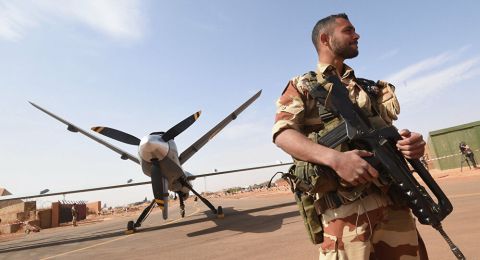
French troops guard a Reaper drone

On 21 December 2019, France carried out a drone strike for the first time, killing seven alleged jihadist fighters in central Mali. In total, 40 terrorists were killed during the weekend-long operations which took place in an area controlled by the group, Katibat Macina. The news of the strike came just two days after Florence Parly, France’s defence minister, said its fleet of MQ-9 Reapers had finished testing with laser-guided missiles at an airbase in Niamey, the capital of Niger.

Until this point, French Reapers in the Sahel-Saharan strip had been used primarily for intelligence, surveillance, and reconnaissance. Now, the French government argues, the idea is for the military to have an additional strike capability in its missions, supporting states in their fight against terrorist groups and thus bringing stability and security to the region. The reality, however, is a little hazier than that.  Read more