Last updated: June 2026
Part Two: UK Drone development programmes
Autonomous Collaborative Platforms (ACP)

In June 2024, the RAF published its ‘Autonomous Collaborative Platform Strategy’ aiming to develop, produce and deploy these new type of AI-enabled military drones. The strategy defines Autonomous Collaborative Platform (ACP) as types of uncrewed systems “which demonstrate autonomous behaviour and are able to operate in collaborative manner with other assets.” Note these type of drones are described as ‘Collaborative Combat Aircraft (CCA)’ by the US.
The idea is for one or more to fly alongside – or in the vicinity of – a piloted military aircraft with the drones carrying out specifically designated tasks such as surveillance, electronic warfare, guiding weapons onto targets, or carrying out air-to-air or air-to-ground strikes. Rather than being directly controlled by individual on the ground, these drones will fly autonomously.
The strategy sets out three ‘Tiers’ of ACP based on their ability to survive in “high-risk” (i.e. defended) environments:
- Tier 1 are disposable drones, with life-cycle of one or very few missions;
- Tier 2 are “attritable” (or “risk tolerant”) that is, expected to survive but losses are acceptable;
- Tier 3 are drones which have high strategic value, which if lost would significantly affect how the RAF will fight.
In May 2025, the MoD announced that the first Tier 1 ACP, called StormShround, had been brought into service. Other ACP are being developed including LANNER/MALFY and an ACP to work in conjunction with Apache Attack Helicopters under Project NYX (see below for details).
The Defence Investment Plan, published in June 2026, committed £300m of initial funding to the development of a larger armed ‘Collaborative Combat Aircraft Programme’. Defence Minister Luke Pollard announced in July that the new jet-powered CCA would be called StormFighter. Both BAE Systems and Boeing have already thrown their hats into the ring with systems already developed or in development. Importantly, the DIP also says that “our CCAs will exploit a sovereign, world-leading propulsion system.”
Other Specific Development Projects
Name
Service
Details
Current State
2026 DiP
Project Aether

Special Forces?
To develop “ultra persistent wide area communications with ISR, using stratospheric uncrewed air systems.”
Order place for three ISR drones in Jan 2025. Details classified but likely to be PHASA-35 and/or Zephyr.
No mention in the Defence Investment Plan
Project ASGARD

Army
An initiative designed to enhance the UK’s reconnaissance and strike capabilities through “a software-defined, network-enabled system.” Three elements of the project are ‘effectors’, digital innovation and ISTAR/ Command, Control and Communications.
Initial purchase of Dart 250 drone under this project for urgent operational reasons.
Reported that Helsing and Palantir likely bidders for command and control network element of this project.
The Defence Investment Plan committed a further £370m for development of ASGARD over the next 4 years on top of the £100m already spent.
Project Brakestop

Army
To develop a jet-powered, long-range, one-way attack drone with a range of around 500km. System must be designed to strike targets while navigating through a GPS-denied environment and withstanding electromagnetic warfare.
Commentators have suggested this project is based on Ukraine’s Palianytsia drone. Could be being developed for Ukraine, UK or both.
No specific mention in Defence Investment Plan but officials told journalists in summer 2026 that system could be operational in near future.
Project Cabot

Navy
To develop and field “a portfolio of crewed, remote operated and uncrewed/ autonomous airborne, surface and sub-surface vehicles” to provide a persistent anti-submarine warfare search capability. Builds upon Project Spearhead/ Charybdis.
Cabot would initially see contractor-owned, contractor-operated systems provide data, triaged by AI/ML algorithms, supplied to a secure Remote Operations Centre for analysis by RN.
Key developments likely dependent on Defence Investment Plan (DIP).
Project Charybdis

Navy
To leverage advances in autonomy, robotics, and Artificial Intelligence/ Machine Learning (AI/ML) to field a persistent and deployable unmanned ASW surveillance capability.
Phase One completed.
Key developments likely dependent on Defence Investment Plan (DIP).
Project Corvus

Army
To procure an uncrewed 24hr persistent ‘Deep Recce Strike Platform’ capable of operating at ranges greater than 80km. Project Corvus seeks to replace the Royal Artillery’s Watchkeeper drones.
Programme is valued at £150m and a new system is expected to be deployed in 2025/26.
Dragonfire

Navy
DragonFire is a laser direct energy weapon being developed by MoD in conjunction with MBDA and other UK companies. Its current development is focused on operating as a counter-drone weapon.
Plans for first operational deployment in 2027 were expanded following further government funding in Spring 2025.
Heavy Lift Challenge Programme

Navy
On-going programmes to develop a range of heavy lift cargo drones mainly in the maritime domain but likely to be used by other services in the future.
A number of Malloy T-150s have been deployed on RN Carrier Strike Group deployment in April 2025.
Key developments likely dependent on Defence Investment Plan (DIP).
Project Hersa
Cross Service
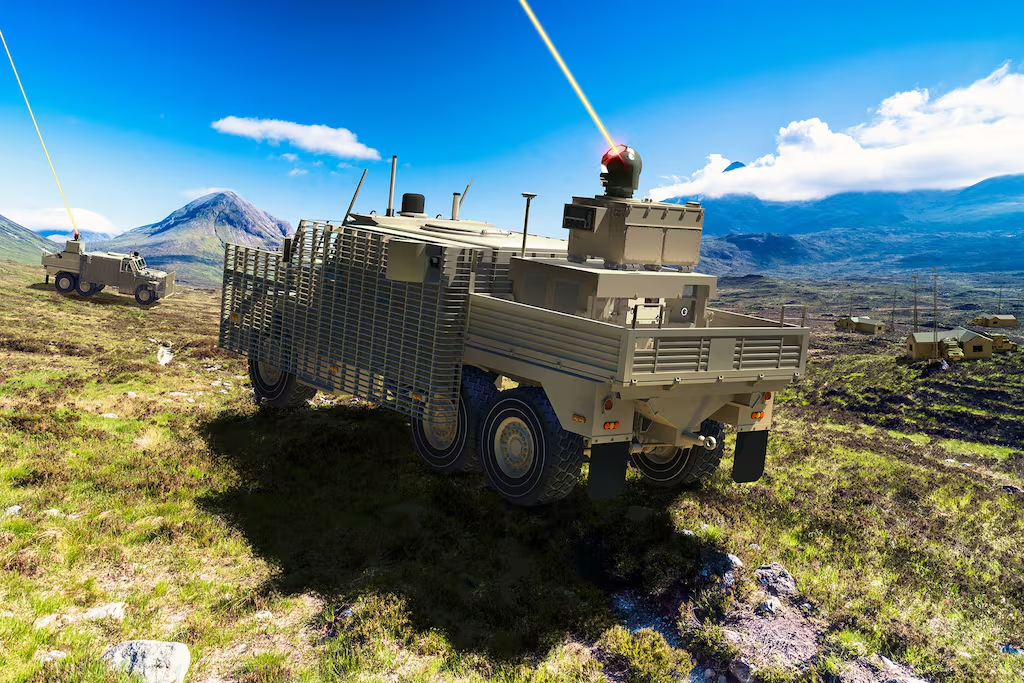
Project HERSA works with industry to develop laser direct energy (LDE) and radio frequency direct energy (RFDE) weapons, doctrine and technology with three key focus areas: LDEW in a maritime air defense application; LDEW in a ground-based air defense application; and RF DEW in a CUAS application in the land domain.
A number of projects have been trialled and tested. Some funding has been allocated but further developments SDR/DIP dependent.
Key developments likely dependent on Defence Investment Plan (DIP).
Human Machine Teaming Framework

Cross Service
The £300 million Human Machine Teaming (HMT) framework aims to use autonomous systems, data and robotics to make faster, more efficient decisions on the battlefield – and to reduce the density of human soldiers where possible.
A number of projects have been trialled and tested. Some funding has been allocated for 2025/6 but seems that further development is SDR dependent.
Key developments likely dependent on Defence Investment Plan (DIP).
Project Instigator

Army/Navy
UK MoD is procuring a one way attack UAS/ loitering munition for use in land and maritime domain with minimum 80km range and loitering time of 45mins.
Programme (previously called MRPS) aims at procuring 200 precision strike loitering munitions with delivery expected in 2027 at cost of £120m.
Lanner

RAF/Army
Lanner is an experimental, long-range one-way attack drone, developed by MoD similar in size and purpose to the Iranian Shahed drones.
Little details is known although it appears to be being developed as part of the RAF’s Autonomous Collaborative Platform programme.
Project Lewes
Army
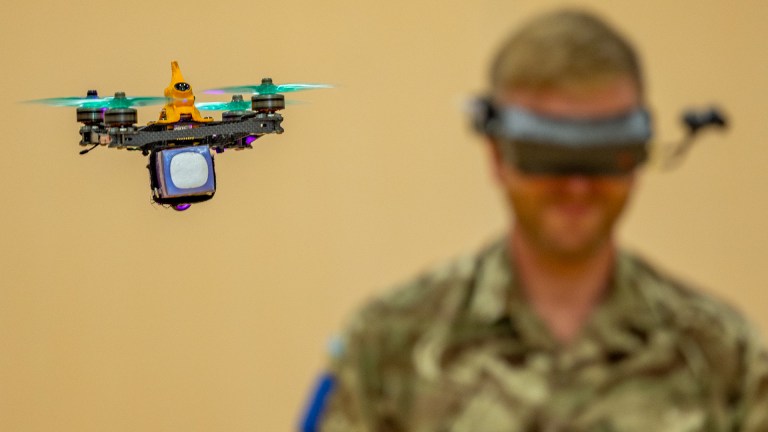
Project Lewes is a British army programme to incorporate new technologies and capabilities into existing forces. As part of this the MoD has been training soldiers to use FPV drones.
A number of projects have been trialled and tested. Some funding has been allocated for 2025/6 but seems that further development is SDR dependent.
Project NYX

Army
Project NYX is aimed at developing fully autonomous drones capable of operating as ‘loyal wingmen’ to Apache Helicopters. Missions are to include reconnaissance, precision strike, target acquisition and electronic warfare
Four companies (Anduril, BAE Systems, Tekever and Thales are developing concepts. Two will be chosen to develop demonstrators
OWE 500+ (Elsa Initiative)

Army
In Feb 2026, Germany, France, Italy, Poland, Sweden and UK agreed to jointly develop a low-cost, long-range loitering munition under the European Long-range Strike Approach (ELSA) initiative – dubbed One Way Effector 500 plus (OWE 500+)
.
Project Proteus
Navy
Project Proteus is the Royal Navy’s programme to develop an uncrewed helicopter that could serve as an alternative to the Merlin, particularly in anti-submarine warfare, resupply and medevac missions. Leonardo was awarded a £60m contract to develop a demonstrator in 2022.
Leonardo unveiled a new design for the Proteus in January 2025 with a first flight planned for 2025.
Key developments likely dependent on Defence Investment Plan (DIP).
RapidDestroyer

Army
RapidDestroyer (previously Project Ealing) is focused on producing a demonstrator in conjunction with Thales to use Radio Frequency Directed Energy Weapons (RFDEW) to detect, track and engage drones using high frequency waves to disrupt or damage critical electronic components inside them.
Live firing of a demonstrator took place at end of 2024. Thales continues to develop RapidDestroyer
Key developments likely dependent on Defence Investment Plan (DIP).
ASW Spearhead

Navy
ASW Spearhead is 7-year, £400 million programme to deliver near-term upgrades and invest in emerging technologies for uncrewed anti-submarine warfare..
Spearhead is funding the Proteus uncrewed air system; and the CETUS extra large uncrewed underwater vehicle (XLUAV).
Key developments likely dependent on Defence Investment Plan (DIP).
Project Tiquila

Army
Project Tiquila aims to deliver cutting-edge small Uncrewed Air Systems (sUAS) to UK Forces whilst also offering spiral capability development opportunities throughout the life of the 10-year project.
The Stalker and Indago drones were procured under this project and it is leading on Project Corvus.
Project Vampire

Navy
Project Vampire seeks to acquire a new fixed-wing aerial drone for the Royal Navy to undertake intelligence, surveillance and reconnaissance, as well as electromagnetic operations.
Banshee Jet 80+ has recently completed tests and it appears further developments await Defence Review decisions.
Key developments likely dependent on Defence Investment Plan (DIP).
Project Vanaheim

Army
Project Vanaheim is a joint US/UK programme focused on tracking, identifying and defeating Class 1 uncrewed aerial systems (UAS). This is “the first wave of a substantial programme” to update CUAS capabilities against the rapid development of small UAS.
Field test events are due to take place from June to August 2025, managed by British Army’s RAPSTONE Task Force.
Key developments likely dependent on Defence Investment Plan (DIP).
Project Vanquish

Navy
Project Vanquish, (previously Vixen) seeks to develop a attritable (Tier 2) Fixed Wing Short Take Off and Landing Autonomous Collaborative Platform (FW STOL ACP)
In November 2023, the UK flew the General Atomics Mojave UAV from HMS Prince of Wales. Ghost Bat has also been suggested as potential candidate for the role.
Key developments likely dependent on Defence Investment Plan (DIP).