The UK’s forgotten war: British drone strikes continue against ISIS

Three weeks ago, on June 10, a British Reaper drone began tracking a motorcycle in north-western Syria near the border with Turkey as it began to be ridden by a someone described by British intelligence as “a known member” of ISIS. The individual, who had apparently been monitored by the drone “for some time” was tracked and killed by a Hellfire missile fired by the drone a short while later. 

Aftermath of UK drone strike in NW Syria, Jun 10 2025 : Image credit : The White Helmets

Local reports from the ground said the man was killed in the blast, with another person also injured and taken to hospital. This was the second British drone strike in north-west Syria this year and the only reason we know about it was a MoD spokesperson boasted about it to The Sun this weekend.

A forgotten, fitful war

For most, the US/UK war against ISIS in Iraq and Syria has been virtually forgotten   Other  awful conflicts –  in Ukraine, Gaza and Sudan –  have taken our attention over the past two years, not to mention the more recent unlawful Israeli and the US bombing of Iran. And in many ways this is understandable.  Russia’s illegal invasion of Ukraine and Hamas’ attack followed by Israel’s on-going genocidal war on Gaza has stunned the world.   

Yet, it should still matter  – particular to British public, media and parliamentarians  – that British forces continue to engage in a seemingly never ending, fitful war in Syria and Iraq.

MoD secrecy 

In addition, the war gets little attention because the Ministry of Defence (MoD) has decided it will no longer talk about ongoing UK military operations. After a decade of responding to our Freedom of Information (FoI) requests on the UK’s use of Reaper drones, for example, the MoD abruptly began to refuse them at the beginning of 2023 arguing that the changed global situation mean that oversight and transparency had to be curbed. Other organisations, journalists and parliamentary committees too have seen a decline in transparency from the MoD, both about UK military operations but also about UK military developments in general.

While MoD has argued that the ‘geopolitical situation’ means they have to be much more ‘circumspect’, the significant drop in the ability of the media, parliament and the public to scrutinise the MoD and hold the armed forces to account will no doubt be welcomed by them for a variety of reasons.   

Read more

Cabinet Minister says UK flying surveillance missions over Gaza

*Important Update (4 December):  Despite stating on camera to two different news programmes that drones had been deployed, the Ministry of Defence has now told journalists that the Minister was incorrect – the UK has not deployed drones but has deployed other surveillance aircraft.   We have amended this blog post.

Late on Saturday 2 December, the Minister of Defence (MoD) issued a short online statement saying that the UK “will conduct surveillance flights over the eastern Mediterranean, including operating in air space over Israel and Gaza.”

On Sunday 3 December, Health Secretary Victoria Atkins, appearing as government spokesperson on Sky News, was asked about the flights and said “The Ministry of Defence has announced that it has sent some unmanned and unarmed, surveillance drones into the region to help look for hostages.”  Subsequently appearing on the BBC’s Laura Kuenssberg show, Atkins repeated that “unarmed and unmanned drones” were being sent to the region to help look for hostages.

Reporting of the MoD’s original statement by BBC and others included a line which stated that aircraft undertaking the missions “will include Shadow R1s, which the Royal Air Force use for intelligence gathering” but this now appears to have been removed from the online statement. The MoD’s statement did not mention drones.

While the  MoD says that “only information relating to hostage rescue will be passed to the relevant authorities” it is likely that electronic, signal and video intelligence of Gaza gathered by the aircraft will end up in the hands of the Israeli Defence Force. If so, many would consider the UK a participant in this horrific conflict which has killed thousands of innocent civilians and seen repeated violations of international law.

While some news organisations reported this as the first UK deployment of aircraft in the conflict, in fact as far back as 13 October the Prime Minister announced that UK surveillance aircraft were to be deployed “to support Israel.”

Since the beginning of 2023, the MoD has increased the level of secrecy surrounding the use of drones, refusing to provide details of UK Reaper operations arguing that it needs “ambiguity” about such deployments.

This latest episode  – where a Cabinet  Minister states on camera that UK drones have been deployed yet the Ministry of Defence refuses to acknowledge the deployment – is another ridiculous example of the secrecy surrounding UK drones.  [Note –  MoD said after this was published that the Minister is incorrect and other aircraft – not drones  – are  being deployed].

Rumour and misinformation about these UK operations are now bound to be rife and could well turn out to be damaging.  While the government will argue that it is undertaking these operations to assist with hostage rescue, it is easy to see how UK aircraft undertaking surveillance operations over Gaza could get further drawn into ‘supporting Israel’ in this horrific conflict.

The reality is that rather than ambiguity and confusion, we need proper parliamentary and public oversight to ensure we do not get drawn further into this conflict.  Rather than deploying more UK military assets, we should be working flat out for a ceasefire.

MoD abruptly ends responding to FoI requests on UK drone operations

MoD goes dark on Reaper operations

After more than a decade of responding to our requests for statistical information about the use of armed drones, the MoD abruptly refused our January 2023 request.  At first we thought it may be an administrative error but it soon became clear that it was a policy decision.

The MoD now argues that the information that it had previously released without any suggestion of harm for more than a decade will now be refused due to the data being related to bodies dealing with security matters (Section 23) and/or national security (Section 24).  Last week, the Information Commissioner finally responded to our appeal, upholding the MoD’s decision based on “confidential submissions” from the MoD.  The Information Commissioners Office wrote:

“Based on submissions provided to him by the MOD during the course of his investigation, the Commissioner is satisfied that the information sought by questions 1b) to 4 of the request either falls within the scope of the exemption provided by section 23(1) of FOIA or falls within the scope of the exemption provided by section 24(1) of FOIA, and that if the exemption engaged is section 24(1) then the public interest favours maintaining the exemption.

The Commissioner cannot elaborate on his rationale behind this finding without compromising the content of the withheld information itself or by revealing which of these two exemptions is actually engaged. The Commissioner appreciates that this is likely to prove frustrating to the complainant. However, the Commissioner would like to emphasise that he has carefully scrutinised the MOD’s submissions and that in doing so he has taken into account the complainant’s position that such information has been previously disclosed.

Transparency thwarted

Summary table of data from FoI requests. Click for full details

Our analysis of the statistical data on UK armed drone operations, gathered via these FoI requests, enabled some understanding of UK’s use of its armed drones over the past decade or more.  Asking a specific set of questions every quarter over several years gave us a dataset which enabled a degree of transparency.

For example when the MoD insisted that its armed drones were primarily used for intelligence gathering – strongly implying drones were rarely being used to launch strikes – the data showed that for periods of time between half and a third of UK air strikes were being carried out by drones.  The data also enabled greater understanding of what was happening on the ground, for example the extent of the switch of UK air and drone strikes to Syria from Iraq in certain periods of the war.  The FoI data also enabled us to discover when strikes had taken place that had not been disclosed by MoD press releases. The data also allowed us to see the number and type of weapons being used and therefore to calculate the cost of the munitions being used. Indeed one response also let slip that the UK drones were firing thermobaric weaponsRead more

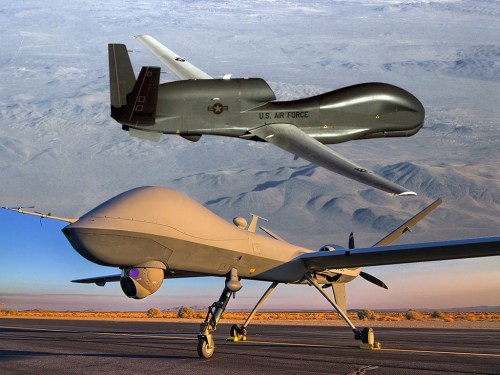
US military drones set to fly from UK from 2024

Top: US RQ-4 Global Hawk, bottom: US MQ-9 Reaper

The US Air Force (USAF) has applied to the UK’s air regulator, the Civil Aviation Authority (CAA), to change airspace rules to allow RQ-4 Global Hawk and MQ-9 Reaper drones to fly from RAF Fairford in Gloucestershire.

The application for Global Hawk flights envisages them beginning in 2024.  A recent update of the Reaper application states that while “the USAFE requirement for MALE RPAS at RAF Fairford remains” it is temporarily pausing the process while it reassesses how to comply with the current regulatory framework.  While nominally described as an ‘RAF’ base, Fairford is wholly operated by the US Air Force.

Currently, drones that fly beyond visual line of sight (BVLOS) are not allowed to fly in the UK unless in segregated airspace. The USAF, through the Ministry of Defence (MoD), is seeking to put in place segregated corridors to allow these drones to transit through UK airspace.  The RAF is currently going through the same process to enable it to fly the UK’s new ‘Protector’ armed drones from RAF Waddington in Lincolnshire.  The USAF may be awaiting the CAA’s decision in this case (due very soon) before proceeding with its application to fly Reaper drones.

According to one document submitted to the CAA, the “working assumption” by the USAF is that the corridors would be activated 2-3 times per week but they are “exploring activation periods that exceed these assumption, both in frequency and time periods of utilisation.”  The proposal is that the drones would take off and land overnight: “all activations will be between 1 hour after sunset and 1 hour before sunrise unless in extremis.”

Lack of oversight

If this change is agreed there will be very little chance of the public  knowing when or where these US drones will be used operationally.  While the government has said previously that combat operations from US bases in the UK are subject to “joint decision” in reality the government has little say or control over operations from US bases as the framework under which they operate  – the 1951 Status of Forces Agreement – gives jurisdiction to the US, not the UK.

This is a very significant move.  While the war in Ukraine will no doubt be at the forefront of people’s thinking in regard to this development, the US uses drones – surveillance and armed – to enable it undertake air strikes right across the globe, both in areas of armed conflict, but also beyond for so-called ‘targeted killings’. The UN, many individual states and international law experts have condemned the use of drones for these unlawful operations describing them as extrajudicial killings which undermine global peace and security.  Read more

EU borders agency must improve information access arrangements following complaint by Drone Wars UK

The European Ombudsman has ruled that the European Border and Coast Guard Agency, Frontex, should reform its access to information arrangements following complaints about difficulties in obtaining information made by Drone Wars UK and German open government platform FragDenStaat.

The Ombudsman’s ruling follows a two year investigation which examined how Frontex deals with requests for public access to documents, and particularly requests submitted by email and through civil society access to information websites such as FragDenStaat and AskTheUK.org.  At present Frontex only accepts communications through its own difficult-to-use communication portal and  refuses to communicate by e-mail or third party information access websites – a complicated and unnecessary hurdle for anyone seeking information about the organisation.

As well as investigating the portal requirement and the ability to submit and to receive documents by e-mail the Ombudsman, Emily O’Reilly also inquired into concerns about restrictions imposed by the copyright of Frontex documents, long-term accessibility of documents through the portal, and Frontex’s requirement for those requesting information to submit personal identification and the lack of routes to allow this.

Border Drones

Drone Wars UK submitted an information request to Frontex in July 2020 as part of our ‘Crossing A Line‘ investigation, in which we highlighted the growing use of drones for border control operations and the threats to human rights which this poses.  Read more

MoD challenged at Information Tribunal on secret UK Reaper drone operations

Drone Wars appeared in court yesterday to appeal the refusal of the Ministry of Defence (MoD) to give basic details of UK Reaper operations outside of its campaign against ISIS in Iraq and Syria.  Judgement in the case is due to be given in around six weeks’ time.

In January 2020 the MoD refused to answer a Freedom of Information (FoI) request from Drone Wars UK seeking the number of UK Reaper flights that had taken place outside of Operation Shader during 2019 and their location. The request was refused both on national security and international relations grounds. Subsequently, Ministers refused to answer questions both in the House of Commons and the House of Lords about the sorties, claiming that Reaper was an ‘intelligence, surveillance and reconnaissance platform’ and that Ministers “do not comment on intelligence matters.”

Labour MP Clive Lewis wrote directly to the Secretary of State, Ben Wallace, about the matter and was told in response:

“REAPER is not conducting strike operations outside those theatres for which Parliament has approved the deployment of UK Armed Forces. The vast majority of REAPER missions are reconnaissance and surveillance operations and as I am sure you can understand, to reveal where it is conducting those missions would provide valuable information to our adversaries.”

Clive Lewis and crossbench Peer, Baroness Viviane Stern, member of the All Party Parliamentary Group on Drones and Modern Conflict submitted written statements to the Tribunal urging the need for transparency. Mr Lewis argued that  the refusal to answer questions about the deployment of Reaper is “a serious backward step in terms of transparency and accountability.”

Baroness Stern stated:

“Despite repeated attempts by myself and colleagues to attain even the most basic information about the UK’s drone deployments, policy, and commitments, Parliament has not been provided with the accurate and timely information needed to meaningfully carry out its constitutional scrutiny role. Whilst certain details must be kept secret in order to ensure operational and national security, the current trend of withholding information about the use of drones purely because it is seen as an “intelligence” asset, as well as withholding vital information on the UK’s growing military capabilities and commitments is deeply concerning and unjustified.”

In court, the MoD argued against the release of the information on two grounds.  Firstly, that the information was exempt from release under Section 26 of the Freedom of Information Act, arguing that the information would prejudice the capability, effectiveness or security of relevant forces.  Secondly, it argued that release of the information was exempt under Section 27 of the Act, in that its release would prejudice relations between the United Kingdom and any other State and/or the interests of the United Kingdom abroad.  Read more