RAF’s new armed drone given approval to fly freely over UK  

Protector RG1 flying over RAF Waddington. Crown Copyright.

The UK’s Military Aviation Authority (MAA) has issued ‘Military Type Certification’ to the UK’s new ‘Protector’ armed drone, meaning that it is now free to fly within UK airspace, including over populated areas.

Previously, for safety reasons, Protector and other large uncrewed systems such as the Protector’s predecessor, the Reaper, were only allowed to fly in segregated airspace, with other aircraft excluded.  Although large military drones are spreading rapidly, as Drone Wars has documented they continue to tumble out of the skies for a whole variety of reasons.

The UK is the first country to certify a large drone to fly freely in unsegregated airspace and General Atomics, the manufacturer of the drone – which they call MQ-9B SkyGuardian rather than UK designation of ‘Protector RG1’– were delighted as it has huge implications for their sales.  The company’s press release called it “a seminal achievement.”  A key element of the  approval, alongside “rigorous testing”, was apparently the ‘rigid separation’ of mission software from flight critical software.

Protector flights in the UK

The Protector has been undertaking a short series of test flights around RAF Waddington, the home of UK drone warfare, over the past few weeks. The Aviationist noted two tests in the past week which were of the longest duration so far, including one which saw the drone fly to RAF Marham before taking off and returning to Waddington.  RAF Marham is the nominated diversion airfield for the drone.

General Atomics reported that 10 of the 16 Protector drones ordered had now been delivered to the UK but it is not clear if these are all at RAF Waddington  as previous drones that have ‘been delivered’ to the RAF remained in the US for testing and trials.  The UK is increasingly secretive about its drone operations and exact details about when Protector is to come into service have been given vaguely as ‘by the end of 2025’.  Reaper is also expected to exit service by the end of the year.

Protector test and training flights are now likely to expand both in number and in range, including flights to launch weapons at Holbeach Air Weapons Range, near Boston in The Wash. Protector carries the Paveway IV guided bomb and Brimstone 3 missiles.

The Ministry of Defence has always been clear that Protector will also be available to support counter-terrorism operations within the UK and undertake Military Aid to Civilian Authorities (MACA) tasks such as assisting HM Coastguard with search and rescue missions.  Read more

Accident waiting to happen: UK opens skies to large military drones as crashes continue

‘Protector’ drone flying from RAF Waddington (Credit; RAF)

As the UK begins to open its airspace to medium altitude, long endurance (MALE) drones for the first time, at least 20 crashes of this type of drone have occurred during 2023. See latest update of our Drone Crash database for full details. It is highly likely that other crashes have occurred that have not been publicly reported.

In November 2023, the RAF began flying its new ‘Protector’ drone (a new version of the Reaper)  from RAF Waddington as part of a short test programme after receiving permission from the Civil Aviation Authority (CAA). The MoD has submitted plans to be allowed to fly drones from RAF Waddington on a permanent basis from Spring 2024.  Meanwhile the US Air Force have submitted plans to the CAA to fly US Global Hawk drones from RAF Fairford in Gloucestershire.  It has put an application to fly US Reaper drones from the base on hold, presumably until a decision is made on the Global Hawk flights.

There are now a wide variety of drones used by the military – from small hand-held surveillance systems through exploding so-called ‘suicide drones, to enormous solar powered systems flying at the edge of space. However, MALE drones like the Predator, Reaper and Bayraktar remain the workhorse of military attack drones but due to a variety of reasons, they continue to regularly crash

US Crashes

At least four MQ-9 Reapers and one MQ-1 Gray Eagle have crashed during the year according to media reports. Details are scant as the US has grown increasingly secretive about  such occurrences with USAF ‘mishap’ data not updated since 2021. Alongside these crashes, a US Reaper drone was downed due to a collision with  Russia aircraft over the Black Sea in March, while a US Reaper was shot down off the coast of Yemen  by Houthi rebels in November.

Date Operator Type Phase/details Location / Report
Nov 18,2023 US Air Force MQ-9 Reaper (?) Mid-flight Off coast Somaliland
Aug 22, 2023 US Air Force MQ-9 Reaper Landing Kanoya, Japan
May 15,2023 US CBP MQ-9 Reaper Mid-flight Arizona, US
Apr 22, 2023 US Army MQ-1 Gray Eagle Mid-flight Kirkuk, Iraq
Feb, 4, 2023 US Air Force MQ-9 Reaper Mid-flight Northern Mali

Bayraktar TB-2 Crashes

At least six Bayraktar TB-2 drones have crashed during 2023.  Two of these occurred after Ukrainian operators lost control of the drones and had them shot down.  Bayraktar’s operated by Burkina Faso and Mali also crashed during the year while Turkish Bayraktar’s operating against Kurdish groups also crashed in Iraq.  Meanwhile the US Air Force shot down a Turkish Anka drone in Syria in October after US forces judged it to be threatening a US military position.  Read more

New ‘Protector’ armed drones to begin flying in UK – Join the protest on 13 November


The UK’s new armed drones – known as  ‘SkyGuardian’ internationally, but renamed ‘Protector’ by the UK –  will begin test flights in the UK next month after the Civil Aviation Authority (CAA) agreed to new airspace rules around RAF Waddington.  The MoD will undertake “a small number of time-critical proving flights” of the new drone ahead of a longer test and training programme due to begin in late 2023/early 2024.

The first of an initial batch of sixteen MQ-9B SkyGuardian was flown into RAF Waddington on-board a transport aircraft on 30 September.

According to Jane’s:

While the Protector fleet will be based at and operated from RAF Waddington, it will spend most of its time overseas in the same manner as the Reaper fleet. A future operational scenario could see the Protector ferry itself from RAF Waddington to a location in the Middle East or Sub-Saharan Africa, arriving in theatre to be met by a team that would arm and prep it for its mission.”

The UK is replacing its fleet of ten Reaper drones with up to 26 of the new ‘Protector’ drones.  The newer drone has further range and longer endurance, as well as being capable of carrying more weapons.  It is also capable of autonomous take-off and landing.

Why we continue to challenge the use of armed drones

As we have argued over the past decade, while remote-controlled drones are presented as enabling ‘pinpoint’ accurate air strikes which enable us to ‘take out’ bad guys without risk to our own forces, the reality is somewhat different. While the UK continues to claim that only one civilian was killed in the thousands of British air and drone strikes in Iraq and Syria, journalists and casualty recording organisations have reported large numbers of civilian casualties from US and UK air strikes.  In addition, as they can be deployed with no or few boots on the ground, making it much easier for political leaders to choose to use armed force.

Armed drones have also enabled a huge increase in so-called ‘targeted killing’ including killing of individuals far from battle zone.  While some argue that it the policy of targeted killing that is problematic, it is hard to deny that the practice has hugely increased with the advent of armed drones. While the US is at the forefront of such operations, the UK too has used its drones to carry out a number of such killings including the killing of a suspected ISIS leader in Syria in December 2022Read more

Public consultation on allowing armed drones to fly from RAF Waddington opened – have your say!

Above us only….drones?

The Civil Aviation Authority (CAA) has formally opened a public consultation on the Ministry of Defence (MoD) proposal to change airspace regulations around RAF Waddington to allow armed Protector drones to operate from the base from 2023. In short, these changes will put in place  a ‘danger area’ around Waddington to allow the drones to take-off and land.

Currently the UK’s fleet of armed Reaper drones are not permitted to fly within the UK as they were not built to appropriate standards.  However the MoD argues that its new drone – called SkyGuardian by the manufacturer but labelled ‘Protector’ by the MoD – has been built to stricter construction standards that should allow it to be certified to fly within UK airspace. Separate from the construction issue is the very significant question as to whether large drones (military or otherwise) can fly safely in airspace alongside other aircraft. Drone advocates argue this can be done though using electronic ‘Detect and Avoid’ (DAA) equipment but this is as yet largely untried and untested.

Map of potentially affected area from CAA website

While this consultation is therefore limited in that it is focuses only on specific airspace changes around Waddington rather than wider questions about the safety of opening UK airspace to large drones, we would urge those concerned about these developments to respond via the dedicated webpage.  All members of the public are invited to respond and it should only take a few minutes.  The consultation is open until 30 November.  Read more

Drone Wars Select Committee submission on use of the military drones in countering migrant crossings

In Sept 2021 the prototype of the UK’s new armed drone flew from Scotland to undertake a mission involving a search pattern over the Channel.

Boris Johnson announced in mid-January that the armed forces was to take charge of limiting migrants crossing the English Channel. The announcement was described by The Times as one of a series of populist announcements by the embattled PM to save his premiership.

Soon after, the Defence Select Committee announced that it was to scrutinize the decision and sought submissions from interested parties:

“The Government’s decision that the Royal Navy should take over operations in the Channel has taken Parliament (and it seems the MOD) by surprise.  There are significant strategic and operational implications surrounding this commitment which need to be explored.”

Shockingly, both the Ministry of Defence and the Home Office refused to submit evidence or send ministers to answer questions from the Committee.

Our full submission to the Committee on this issue – looking in particular at how drones are often seen as a ‘solution’ – is available on their website, while here we offer a short summary.

  • Drone Wars argues that the military should not be involved in day-to-day border control operations in the absence of any threat of military invasion. This role is primarily a policing and enforcement role centred on dealing with civilians which should be conducted by civilian agencies.  Military forces are not principally trained or equipped to deal with humanitarian or policing situations.  The UK borders are not a war zone, and civilians attempting to enter and leave the country are not armed combatants.

Read more

RAF drone programmes fly into stormy skies

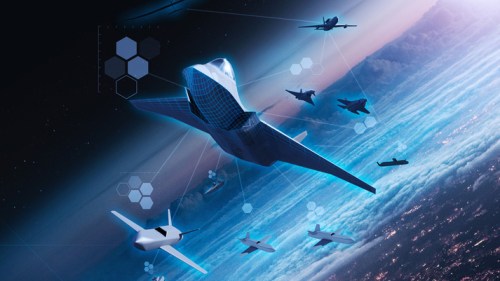
BAe System image of Tempest aircraft with accompanying drones

Funding for the ‘Tempest’ Future Combat Air System which is intended to replace the RAF’s Typhoon aircraft is “significantly less than required” and “adds significant overall programme risk” to delivery of the new jet, according to a report on government project management published jointly by HM Treasury and the Cabinet Office.

In its first assessment of the Tempest programme the Infrastructure and Projects Authority (IPA), which reports jointly to the two government departments, reveals that successful delivery of the aircraft is already “in doubt”.  Another high profile drone project, delivery of the RAF’s new ‘Protector’ aircraft, rated a similar assessment.

Tempest is under joint development by Italy, Sweden, and the UK as the next generation combat aircraft for the three nations – a high performance, high cost system consisting of a core aircraft, which is likely to be able to fly in both crewed and uncrewed modes, with an associated network of swarming drones, sensors, and data systems.

The IPA, which each year rates the performance of government departments in delivering major projects, has scored the Future Combat Air System programme with an Amber / Red risk rating in its report for the 2020-21 financial year.  This means that “successful delivery of the project is in doubt, with major risks or issues apparent in a number of key areas. Urgent action is needed to address these problems and assess whether resolution is feasible”.  Read more