Drones at DSEi 2011

BAE Sytems Mantis drone at DSEi 2011

Drones were big news at this year’s DSEi arms fair, with many of the smaller ‘niche’ players launching new product and the ‘big boys’ showing off their wares and engaging in verbal fisticuffs about whose drone was  biggest/ brightest/best.

BAE Systems displayed their Mantis drone at the fair and were reportedly “confident” that their proposed new drone, dubbed Telemos (to be developed jointly with Dassault) would win the contract for the UK’s next generation drone.  EADS, meanwhile, the other giant of the European military industry is fighting its corner for its own drone; Talarion.  Fox News reported that the EADS CEO was “furious” that France is apparently going to choose the BAE Systems/Dassault proposal.
EADS reaction is so strong because they do not want to be left out of what many see as the key market in the global arms trade over the next few years.  While the new UK-France drone contract is estimated to be worth  between £1bn -£2bn, the global drone market over the next three years alone has recently been predicted to be worth around $14bn.  With Israel companies and US drone giant General Atomics already firmly

iStart mini-drone from Blue Bear Ltd

established in the market, winning funds to develop a future European combat drone is vital for these military corporations.  Many, not least the UK’s Defence Minister Peter Luff, has predicted that there will be no more ‘manned’ aircraft developed after this current generation of fighters; the future they suggest is drone.

Increasingly it is not just the large military companies involved in the drone wars.  Smaller companies are also seeking to get their foot in the door.  For example Blue Bear, a Bedford-based company launched a new ‘man-portable’ drone called iStart at DSEi.  As reported in Shephard News:

The platform can go ‘from box to launch in under five minutes’ and the only time-consuming thing during a mission is ‘waiting for the GPS’.  [It] has a ‘shake and start’ engine, a 40 minute endurance, and folded wings for easy carriage. It is derived from the company’s larger Black Star, of which the UK MoD is a customer.   It was developed in 18 months with police input, and is ultimately designed for special forces operations, [Company spokesperson] Williams-Wynn said.

An excellent article on other small drones on show at DSEi this year, including Spy Arrow, Shirk and Switchblade can be read here at the National Defense Magazine blog.

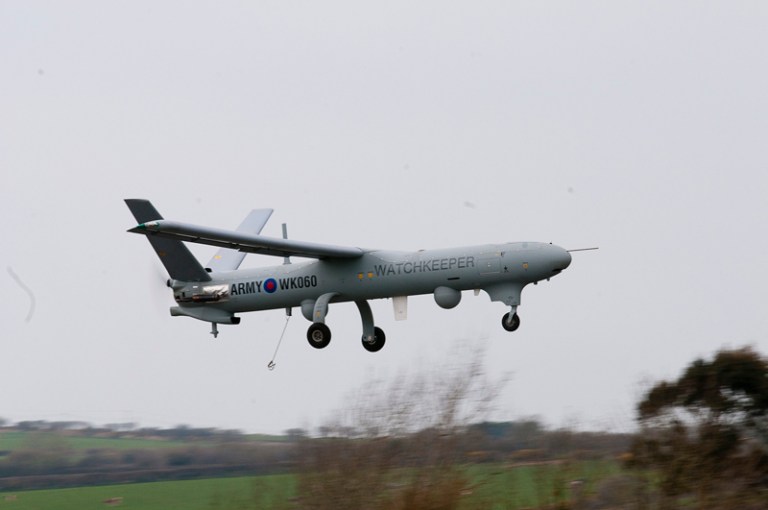
Thales, joint manufacturer of the new Watchkeeper drone along with Israeli company Elbit, were also at the arms fair and promoting Watchkeeper .  Below you can watch a short clip of Nick Miller – Thales business director for UAVs – promoting Watchkeeper during the DSEI fair (clip from flightglobal.com)

[vodpod id=ExternalVideo.1003873&w=425&h=350&fv=videoId%3D1159660529001%26playerID%3D18065281001%26playerKey%3DAQ%7E%7E%2CAAAAAEhanPQ%7E%2Cgw69HqZGImtgx6jHMIRJqCyNIEson6Zm%26domain%3Dembed%26dynamicStreaming%3Dtrue]

posted with vodpod

The much delayed Watchkeepers  are (finally) due to come into service by the end of 2011 and will gradually  replace the Hermes 450 drones that the UK has been renting from Israel for the past four years.  This of course creates  a business ‘opportunity’ – anybody want to buy a squadron of second-hand, slightly used Israeli drones?  Elbit, it seems are open to offers.

Meanwhile, Qinetiq, were promoting their ‘West Wales UAV Centre’  – where the Watchkeeper drone is currently being tested – at DSEi.    The owners of the centre at Parc Aberporth,  site of a number of protests against drones already , are keen to attract more drone manufacturers.  While each individual Watchkeeper drone  will undergo testing at Parc Aberporth until at least 2014, it appears there is still plenty of room for more drones –  and no doubt more protests.

Speaking of which, the Fellowship of Reconciliation and SPEAK organised a protest outside General Atomics’ London office during the DSEi arms fair.  The manufacturers of the Predator and Reaper drone were curiously absent from DSEi this year – so protesters went to visit them.  Below you can seen Amy Hailwood of FoR speaking about drones against the background of the protest.
Drone industry gets updates on Reaper and Watchkeeper operations

On 8 September, the UK MoD’s Air Warfare Centre held what is apparently an annual symposium on drones at the Shrivenham Defence Academy. While the overall theme of the symposium was how drones could help ‘UK Resilience Operations’, attendees were also given updates by senior military officials on the progress of the UK’s  major drone programmes: Reaper and Watchkeeper.

We have asked the MoD for a full copy of the updates under the Freedom of Information Act (FoIA) and will post them here when (if!) our request is accepted.  Meanwhile we will have to reply on the reports of the briefings according to an article in Shephard News.   According to the article Wing Commander Gary Coleman briefed delegates about the Reaper:

The RAF’s fleet of MQ-9 Reapers purchased under a UOR for operations in Afghanistan has now completed 25,000 flight hours. The RAF’s Reaper community is now doubling in size to 10 aircraft and a second squadron – XIII Sqn – is being reformed onto the Reaper to begin ground control station operations from RAF Waddington in Lincolnshire. With a fleet of 10 aircraft and 44 crews, the RAF will be able to provide three ‘combat air patrols’ or CAPs over Afghanistan 24 hours a day, seven days a week.

Wing Commander Gary Coleman, HQ 2 Group ISTAR (Land), told delegates that crew retention had been an issue as aircrew were being based at Creech AFB outside Las Vegas for three years away from family and friends in the UK, flying operational missions and then returning home to family.

He also pointed out that the time differences between Afghanistan and Creech meant that while the aircraft was flying in daylight over Afghanistan, the crews at Creech would be working night shifts flying it. Coleman hopes that the time differences will be addressed when flying begins from Waddington which is just four hours behind Kabul time.

He did point out that the Reaper community had enjoyed an influx of personnel from the Nimrod fleet, which was taken out of service in May 2010.   An experimental training programme, Project Daedalus, trained a group of four non-aircrew including two air traffic controllers, a fighter controller and a policeman in the United States to fly the MQ-1 Predator. The four were amongst the top-rated in their class beating pilots with fast jet experience. There is now some consideration in training the four up to fly the MQ-9.

Shephard News also reported  on the update by Major Matt Moore of the Watchkeeper Implementation Team.  According to the article Moore reported that the British Army’s new Watchkeeper UAS has flown its longest flight yet during a test flight from west Wales.

A test flight in the beginning of September from the Parc Aberporth flight test centre saw the Watchkeeper fly for 14 hours and out to a range of 115 km, making the sortie the longest both in terms of range and endurance…

‘We launched the air vehicle at dawn and we recovered it at dusk as we are currently limited to testing in daylight hours only, but we still had another four hours of fuel in the tank.’

Watchkeeper has now completed some 320 hours of flight testing over 230 flights and Moore said the programme is still on track to be fielded in Afghanistan in the first quarter of 2012.

In preparation, a number of modifications have been made to get the aircraft ready for operation in Afghanistan including the addition of covert lighting as well as additional IT systems in the ground control station to make it more compatible with systems being used in theatre.

Personnel began training for Watchkeeper in May. As well as flight testing at Aberporth, the Royal Artillery will also conduct training flights from MoD Boscombe Down in Wiltshire from where the aircraft will be flown in airspace specially allotted for UAV flying around and to the south of the Salisbury Plain Training Area. Royal Artillery crews will also be able to use the grass airstrip at Upavon for rough field or austere flight operations with the system.

Moore also said his team was exploring the potential of partnering the Watchkeeper with the Army Air Corps Apache attack helicopter, so that the Watchkeeper could cue or send the Apache imagery of potential targets.

As well as this Shivenham confernce and the ASTRAEA conference reported below, the DSEI arms fair has generated a lot of news about drones, whihc we will cover in the next post.

Waiting for the Watchkeeper?

The UK's Watchkeeper drone being tested in Israel: Copyright Thales

News of the progress (or rather lack of it) on the UK’s Watchkeeper drone programme has emerged over the last few days.   Due to enter service in February 2010, delayed to Spring 2011, the latest information according to Flight International,  is that it will not be deployed in Afghanistan “before the end of the year” due to, as Thales executives helpful put it “technical difficulties.”

Watchkeeper is being built under a £900m MoD contract (the latest NAO report shows that £625m has already been spent on the project !) by a joint British–Israeli venture company (U-TacS) owned by Thales UK and Elbit Systems.  It is based on the Israeli Hermes 450 drone which the UK is currently renting in an innovate ‘pay by the hour’ operation for use in Afghanistan.  Watchkeeper will (eventually) replace the Hermes in Afghanistan.

Flight tests of Watchkeeper are being undertaken from Parc Aberporth in West Wales and on 17 April 2010 Watchkeeper went on her maiden UK flight.   A  500 square mile test zone for UAVs between Parc Aberporth and Epynt Mountain is currently being considered (See correction below).   Thanks to a helpful FoI inquiry we know that up until mid-February 2011, 13 test flights have take place in the UK since then (till Feb 2011).  Other flight tests of Watchkeeper are taking place in Israel.  Incidentally the Welsh Assembly has also applied for planning permission to use Llanbedr Airfield in Harlech for “research, development, testing and evaluation of Unmanned Aerial Vehicles (UAVs).” (Thanks David)

Parc Aberporth

The first ten Watchkeepers, which were due to be assembled in Israel, have already been built according to the Flight International article and training of armed forces personnel for the new drone will begin at Larkhill Artillery Training Centre in May.   Following initial training there will then be operational exercise for Watchkeeper using temporary restricted airspace above Salisbury Plain after taking off from the MoD’s Boscombe Down test centre.

In an interesting sideswipe at the project , The Register argues that at a cost of £16.5m each, the 54 Watchkeepers are hugely expensive and, possibly, not even wanted by the Royal Artillery.   Watchkeeper “isn’t about jobs or British industry or weapons for the armed forces”, it says ”it’s mainly [about] pumping hundreds of millions of pounds into French and Israeli arms companies .”

Wandering Raven has more information (including a helpful list of Watchkeeper component manufacturers) and regular updates on the Watchkeeper drone – see the Wandering Raven Watchkeeper stream. 

Correction: The orignal post said that this testing area had already been approved.  It has been pointed out (thanks JG) that the consultation is still on going as of May 2011)

British troops learn drone war in Israel as Reaper replacement battle starts

‘UK Troops Use ‘War Crime Drones’ In Israel was a rather surprising headline this week from the sensational Sun Sky News.  Behind the headline was the news that British troops are being trained by Israeli company Elbit to use Hermes and its Watchkeeper drones replacement in Israel.

 As is well known the UK is currently renting Hermes drones for use in Afghanistan until the new Watchkeeper drones, built under a joint UK-Elbit venture, can be deployed next year.  (see British Drones the Israeli Connection)

In 2008 the UK government insisted that trials for the Watchkeeper should not be undertaken in the occupied territories but was seemingly happy enough for the testing to take place in Israel. Amnesty International was quoted in the Sky News article as saying “It would seem wholly inappropriate for UK forces to be trained in the use of drones by a country with a track record of applying this technology in grave abuses of people’s human rights.”  Quite. No one could disagree with that (except perhaps commentators on  The Jersualem Post version of the story)?

Meanwhile the battle to replace the British Reaper drone is sparking into life.  EADS, which is developing the Talarion drone, urged decision makers to ‘make a choice’ with regard to the future armed UAV.   Two drones, BAE’s Mantis and EADS Talarion are the main contenders but there are also other possible candidates which could be developed to fulfil the Scavenger requirement to be in service around 2015-2018.  The joint UK-France treaty signed late 2010 seems to imply that these two main programmes will somehow be merged but it seems progress is slow and frustrating for EADS.

Drones and the Farnborough ‘airshow’

There has been much drone news over the past ten days, much of it generated by the Farnborough ‘airshow – in truth more of an arms/aerospace fair-  so I thought I would do a quick round-up.  

General Atomics Avenger

General Atomics, maker of the Predator and Reaper drone were much in evidence at Farnborough and received lots of press coverage, including a profile piece on General Atomics owner, Neal Blue, in the FT.  At the airshow, General Atomics revealed that they had won approve from US regulators to export the unarmed version of Predator to Saudi Arabia,  Egypt, U.A.E. and Morocco, and had applied for a license to sell to Pakistan.    How long they will stay unarmed is anyones guess. 

General Atomics though were in town mainly to pitch  their new drone, Avenger, an upgrade of the Predator and Reaper to the RAF.    Avenger had its first flight in April 2010 and is now in flight testing.  Aviation Week revealed more detail about Avenger including that it will be produced in different variants.

Drone downed by Laser

Farnborough was also the setting for the news that Raytheon had downed a drone (four actually) by laser.  This also gained much coverage (including this wonderfully daft article in the Sun). “This was a bad day for UAVs, and a good one for laser technology,” said Raytheon Missile Systems’ vice-president, Mike Booen in the Guardian.

CIA Drone Guy Becomes New Top Spy

was how Wired News reported that John Bennett was to be the next chief of the National Clandestine Service, the operations side of the CIA.    Bennett, according AFP, oversaw the Predator drone ‘program’ in Pakistan.

Zephyr – the eternal drone

Zephyr, the Qinetiq developed solar unmanned drone completed its record breaking 14 day flight on 22nd July.  Launched by hand, the 22 metre wingspan aircraft flies by day on solar power which is then used to recharge the lithium-sulphur batteries, which are used to power the aircraft by night.   Although Qinetiq is a British company, the flight trial took place at a US military range in Arizona as the US military are very interested in the aircraft that can provide low-cost, non-stop surveillance over months rather than days.

Speaking to the BBC about Zephyr, which has been dubbed the ‘eternal drone’, project manager Jon Slatmarsh cut to the chase: “Qinetiq is now looking to the Ministry of Defence and the DoD (US Department of Defense) to put a system into service.”

Footprints….

A briefing by Thales UK business manager at the Airshow led to the Telegraph headline ‘’Watchkeeper drone can detect footprints from above clouds’.   The reality is as the Register reported, the Anglo-French I-MASTER radar on Watchkeeper “allows images of the same piece of ground from different times to be compared – detecting vehicle tracks and even footprints which may have been left since the first image was taken.”

British Drones – the Israeli connection

Joint British-Israeli Watchkeeper drone in test flight at Aberporth

While the UK  is developing its own “sovereign” drones at BAE Systems and using Reaper drones bought from the US, there is also a strong Israeli connection as the UK are leasing Israeli drones for use in Afghanistan and also jointly developing a new surveillance drone called Watchkeeper.

Israel is the world’s leading exporter of drones with more than 1,000 sold to different countries netting Israel around $350m a year.    Israel’s primary combat drones are the Hermes, produced by Israeli company Elbit Systems Ltd, and the Heron produced by Israeli Aerospace Industries.   According to Ed Kinkane in the Palestine Chronicle “as far back as 1982 Israel used drones against Syria. In the early nineties Israeli drones were used in the Kosovo campaign and Israeli drones invaded the skies over Lebanon and patrol occupied West Bank and besieged Gaza”.   A recent Human Rights Watch report details the use of armed drones by Israel in Gaza.

In October 2005 the UK government awarded a $500m contract to UAV Tactical Systems Ltd. (U-Tacs) a joint venture company  formed by Thales UK and Israeli company Elbit Systems, based in Leicester,  to build up to 100 Watchkeeper UAVs.    Watchkeeper is a derivative of the  Israeli Hermes 450 drone but differs in having an automatic landing capability and multiple payload configuration.

In April 2010, Elbit announced that it had signed a $70 million deal to provide maintenance and logistical support for the Watchkeeper project. The announcement came the very day the Watchkeeper drone made its maiden test flight, logging 20 minutes in the air in Wales.

Since July 2007, the UK has also been leasing Israeli Hermes 450 from Thales UK in an innovative ‘pay by the hour’ contract  for use in Afghanistan until the Watchkeepers are in service.   By April 2010, the leased drones had flown more than 30,000 hours over Afghanistan and the contract is likely to be extended until the Watchkeeper drones are ready to go into service in 2011