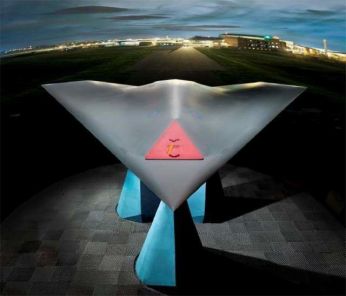
Wither Telemos?

Mock up of Telemos drone on display

British and French Defence Ministers Phillip Hammond and Jean-Yves Le Drian met in London on Tuesday to discuss progress of the Anglo-French defence treaty signed in 2010.  A key element of the treaty was to work jointly on unmanned drones and related technology (see this previous posting).

BAE Systems and Dassult Aviation, who are working together on a proposed medium altitude, long endurance (MALE) drone called Telemos had suggested that contracts could be signed at the Farnborough airshow earlier this month, and when that failed to happen it was suggested that an announcement would be made at this week’s Defence Ministers meeting.  However no such agreement or contract has been signed and there was not even a  mention of Telemos in the post-meeting statement.

Two different agreement were reached about drones.  Firstly a relatively small contract (€13 million) was signed to undertake further basic research work on a future combat drone preliminary dubbed the Future Combat Air System (FCAS) intended for use between 2030 and 2040. Secondly France agreed to evaluate the British-Israeli Watchkeeper drone.  According to DefenseNews “France is acquiring one system from the U.K. to conduct tests and operational studies, expected to last to mid-2013, which may lead to a future French Army acquisition.”   

The silence on Telemos in the post-meeting statement is deafening.  The new administration in France said in May that it was going back to ‘square one’ on the development of a new armed drone   and it seems as though France is keen for Germany and the European conglomerate, EADS to be allowed into the project to join BAE Systems and Dassault.  Some in France are suggesting that France may opt out altogether of investing in a new MALE drone and simply acquire the Reaper from the US.  If this happens in theory the UK could just continue with developing the new drone on its own – presumably based on BAE’s Mantis drone.  By coincidence (!)  BAE has just announced that the Mantis prototype is being brought out of moth-balls and will begin to undertake more flight tests.  However the cost of developing and operating a new drone has been estimated by the MoD to be in the region of £2 billion – a huge amount to invest in a new weapon system at this time of severe economic difficulty.

Latest news on British drones

Some new information has emerged this week about future British drone programmes as BAE Systems held a media briefing at their Warton site to talk about their unmanned projects (our invitation was presumably lost in the post).

Picture of Taranis at Warton, released by BAE Systems.

According to the report by Defense News the first flight of BAE’s Taranis drone has been put back yet again until 2013.  Originally due to make its maiden flight in 2011, it was first delayed until early 2012 for “technical and other reasons” but now won’t fly at all this year.  Little has been heard about Taranis since it was unveiled to journalists (and protestors) in July  2010.  At the briefing journalists were allowed a distant peak at the drone as it sat in its hangar.  The UK government gave BAE Systems £40m of funding to develop unmanned combat systems in January 2012.

Perhaps surprisingly BAE told reporters that it was restarting its Mantis programme. Mantis is an armed medium altitude, long endurance (MALE) drone of similar size and shape to the Reaper.  Unlike Reaper, however Mantis is not remotely controlled but flies autonomously following a pre-programmed flight plan.  Mantis reached the end of its development phase when it flew for the first time at the Woomera test range in Australia in October 2009. Until now it has been suggested Mantis would simply form the basis of the proposed joint BAE-Dassault drone, Telemos.

BAE also said it hoped it would sign contracts with the UK and French government to further develop the Telemos drone  at the Farnborough airshow next month.  Telemos is BAE and Dassault’s offering to fill the UK-French ‘requirement’ for a new armed drone. However the change of administration in France has created uncertainty about the proposal as the newly appointed French defence minister announced in May that he was going back to “square one” on the plan to build a joint military drone.  

Elsewhere BAE continues to undertake work to in order to allow unmanned aircraft to fly within UK airspace.  As part of the ASTRAEA (Autonomous Systems Technology Related Airborne Evaluation & Assessment) programme, BAE will begin undertaking a series of test flights using a converted Jestream aircraft that can fly autonomously as an unmanned aircraft.   At least twenty test flights will take place over the Irish sea over the next six months.  BAE issued a glossy diagram to explain the work that they will be undertaking (large pdf here). 

The other main ‘British’ drone, Watchkeeper – which is being jointly developed by Israeli company Elbit Systems and Thales UK – seems to have missed out on being chosen by the French army as their new drone.  As part of the Anglo-French defence treaty, France was supposed to consider Watchkeeper for the contract but it was announced this week that they have instead bought further Sperwer MKII drones from French company, Sagem. Given this new contract and the fact that France have announced they are withdrawing early from Afghanistan it is unlikely that the French will want Watchkeeper as well.   For more info on Watchkeeper follow Wandering Raven’s blog and see this recent comprehensive article.

Finally, I can’t finish a post about British drones without mentioning the Reaper.  The Guardian reports this week that British reapers have now fired 281 weapons in Afghanistan up until the end of May 2012 and rightly points out that MoD continues to insist that only four civilians have been killed in these British drone strikes whilst at the same times maintaining that they cannot know how many people have been killed.  

 In the article, human rights lawyer Erica Gaston argues

“there has been little to no visibility on how drone targets are selected or reviewed. There have been many cases in Afghanistan and elsewhere in which the visual identification of a “target” through drone technology proved catastrophically wrong. Such past mistakes have raised the bar on the level of transparency and public accountability required. The ‘trust us’ approach is no longer good enough where drones are involved.” 

Quite. Interestingly, the Labour MP Madeleine Moon, who is on the Commons defence select committee, also said: “Greater priority must be given to ensure those killed in drone attacks are not innocent civilians. Current figures coming out of the Ministry of Defence do not indicate that the level of scrutiny needed is in place. It is imperative that steps are put in place, not only to protect innocent civilians, but demonstrate that have done so.”

In stark contrast to this suggestion, the MoD have written to me (letter here) saying they will no longer answer my Freedom of Information requests on the use of UAVs in Afghanistan “until at least the end of operations in Afghanistan.”  Needless to say I have appealed (letter here) and will continue to demand more transparency and public accountability on the use of  British drones.

UK-France declaration on drones

At the UK-French summit in Paris today, David Cameron and President Sarkozy agree a new Declaration on security and defence.  The relevant section on drones (paragraph 16) reads: 

Unmanned air systems are crucial to success in the battlefield, as the Libya and Afghanistan campaigns have shown. We have agreed today to take forward our planned cooperation on UAS within a long term strategic partnership framework aimed at building a sovereign capability shared by our two countries. This framework will encompass the different levels from tactical to MALE in the mid term and UCAS in the long term:

Medium Altitude Longue Endurance (MALE) Drone: The Joint Program Office was launched in 2011. We will shortly place with BAES and Dassault a jointly funded contract to study the technical risks associated with the MALE UAV. We look forward to taking further decisions jointly in the light of the outcomes of this risk reduction phase to ensure that our respective sovereign requirements will be met in a cost effective manner.

– Watchkeeper drone: France confirms its interest for the Watchkeeper system recognising the opportunities this would create for cooperation on technical, support, operational and development of doctrine and concepts.  An evaluation of the system by France will begin in 2012, in the framework of its national procurement process, and conclude in 2013.

– We affirm our common will to undertake in 2013 a joint Future Combat Air System Demonstration Programme that will set up a co-operation of strategic importance for the future of the European Combat Air Sector. This work will provide a framework to mature the relevant technologies and operational concepts for a UCAS operating in a high threat environment. We will begin as soon as 2012 the specification of this demonstrator with a jointly funded contract under the industrial leadership of our national fighter aircraft industries (Dassault-Aviation in France and BAE Systems in the UK).


Anglo-French drone takes another step forward

Summary:   Drones are the latest ‘must have’ weapon systems and the big military companies are desperate to be part of what is beginning to be called ‘the drones gold-rush’.   While Cameron is keen to emphasize that only a ‘few tens of millions of Euros’ are being spent at this time, early figures from the MoD indicate that the new drone could cost the UK around £2 billion with other estimates much higher.  The wider legal and ethical questions about the growing use of armed drones are simply being ignored.
 

Today’s announcement that the UK and France will jointly develop a new armed unmanned drone  is seen by many commentators as inevitable.  Drones are the latest ‘must have’ weapon system and it is important they say, that the UK keeps up with the US and Israel in this key market.   In corporate speak, the ‘direction of travel’ is clear; while companies may squabble over particular contracts and deals it is important that the UK is part of what is beginning to be call ‘the drones gold-rush’

Questions

Behind this ‘gold-rush’ however are many serious legal, ethical and moral questions which are not being properly addressed.  And it is not just us who are saying so.

Last April the Ministry of Defence (MoD) published a Joint Doctrine Note examining the technological and scientific issues related to current and future use of armed and unarmed drones.  The document agreed that there were significant moral, legal and ethical issues involved, and in a key passage (517) considers whether unmanned systems will make war more likely:

“It is essential that, before unmanned systems become ubiquitous (if it is not already too late) that we consider this issue and ensure that, by removing some of the horror, or at least keeping it at a distance, that we do not risk losing our controlling humanity and make war more likely.”

The passage concludes  “What is needed is a clear understanding of the issues involved so that informed decisions can be made.”   

Unfortunately, the last thing that the MoD or the drone industry wants at the moment is a public debate about the growing use of drones.  The report when publicised by Drone Wars UK and the Guardian was withdrawn from the MoD website (although it did quietly return months later) and the authors were dispatched to Afghanistan.   Instead the MoD  decided to launch a “communication strategy” to win over public opinion in support of armed drones with the key message being to “stress the equivalence of  RPAS [drones] to traditional combat aircraft.”

However there are clear differences between drones and manned aircraft, in particular the way there are being used to loiter over particular areas to seek ‘targets of opportunity’ and their increasing use in targeted killing away from any battlefield.  Some of the questions that need to be asked are:

  • Does the geographic and psychological distance between the operator and target make a positive or negative difference? 
  • Does using unmanned systems mean attacks happen more often? 
  • Does faith in the supposed accuracy of drone sensors and cameras mean that commanders are more willing to undertake ‘riskier’ strikes (in terms of possible civilian casualties) than they would previously have undertaken?

All of these questions and many more need to be debated openly and honesty and require careful analysis and clear-headed judgment based on the available evidence. Unfortunately, that evidence, is being kept strictly under wraps by the Ministry of Defence and they are refusing to engage in a debate on these issues. 

While David Cameron is keen to stress that at this stage only (only!) ‘a few tens of millions of Euros’ are being allocated towards developing this new drone the costs will soon soar.   Early figures from the MoD indicate that the new drone could cost the UK around £2 billion but other estimates are much higher.

Background

In November 2010  the UK and France signed a defence and security cooperation treaty which included a commitment to work together on nuclear issues and armed drones.  The two countries have agreed to build a new armed drone and BAE Systems and Dassault have joined together to offer the proposed Telemos drone to fulfill this ‘need’.  All indications are that the new drone will be based on BAE’s Mantis drone, although Dassault have also been working on a drone called ‘Neuron’.

EADS, meanwhile, the other giant of the European military industry is fighting its corner for its own drone; Talarion.  Fox News reported that the EADS CEO was “furious” that France is apparently going to choose the BAE Systems/Dassault proposal.

EADS reaction is so strong because they do not want to be left out of what many see as the key market in the global arms trade over the next few years.  While the new UK-France drone contract is estimated to be worth around £2bn, the global drone market over the next three years alone has recently been predicted to be worth around $14bn.  With Israel companies and US drone giant General Atomics already firmly established in the market, winning funds to develop a future European combat drone is vital for these military corporations.

 For more details see The Drone Wars Briefing

The French drone ‘crisis’

Nicolas Sarkozy, Dassault and.... the Union Jack!

Prime Minister David Cameron will meet French President Nicolas Sarkozy today in Paris for bilateral talks.  While the agenda will no doubt be dominated by the Euro crisis, they may well have a quick word about drones too.

Last November  the UK and France signed a defence and security cooperation treaty which included a commitment to work together on nuclear issues and armed drones.  The two countries have agreed to build a new armed drone and BAE Systems and Dassault have joined together to offer the proposed Telemos drone to fulfil this ‘need’.   An announcement on the deal was expended earlier this year and then postponed for 12-18 months.

While today’s meeting was originally supposed to be a full-scale summit between the countries including Defence Ministers and  with, according to the Guardian, representatives of BAE Systems and Dassault Aviation also present – it was suddenly announced on Monday that the summit has been postponed until next year with just Cameron and Sarkozy to meet instead.

While the Euro is of course the crisis of the hour, the issue of drones has become a hot political topic in France recently.  While the proposed British-French drone won’t be ready till around 2018, the French military want to buy some ‘off-the-shelf’ drones as a stop-gap measure.    The military have chosen to buy the Israeli  Heron-TP drone (IAI have teamed with Dassault to offer the drone) but a French Senate report released last week is highly critical of the decision and is urging the military to accept the bid from General Atomics (teamed with EADS) for the Reaper drone instead. The military’s choice was also the more expense one with the Heron drone bid coming in at €320 million as opposed to the ‘cheaper’ Reaper drone bid of €209 million.

Head of Dassault, French industrialist Serge Dassault (who sits in the French Senate as a member of President Nicolas Sarkozy’s ruling conservative party) was outraged that the Senate should interfere in arms procurement in this way saying it would cost jobs and stifle France’s arms industry.

“We proposed the Israeli drone to meet an obvious gap in drones today… If we buy an American one, well then everything is screwed up and we’ll spend more money, drive up unemployment and reduce exports – if that’s what you want, I don’t understand,” the 86-year-old head of said. “

Worse was to come for Serge as the French Senate this week actually cut the military budget available for the interim drones by  €100million seemingly forcing the military now to buy the American Reaper drone  instead.

Complicating European drone matters even more, German Defence Minister Stéphane Beelemans argued this week that EADS should be included in the proposed Anglo-French drone project, Telemos.  EADS have their own separate future drone proposal, Talarion, but it seems unlikely at this stage to go anywhere.  As Defence News reported this week : “EADS seeks a place at the top table in the Telemos project alongside BAE and Dassault, but Dassault will only consider a junior subcontractor role for the pan-European company, retaining leadership firmly in the hands of the Anglo-French team.”

With all this going on, if drones do come up at today’s Cameron-Sarkozy meeting, officials may wish their masters had stuck to the simple task of solving the Euro crisis.

Drones at DSEi 2011

BAE Sytems Mantis drone at DSEi 2011

Drones were big news at this year’s DSEi arms fair, with many of the smaller ‘niche’ players launching new product and the ‘big boys’ showing off their wares and engaging in verbal fisticuffs about whose drone was  biggest/ brightest/best.

BAE Systems displayed their Mantis drone at the fair and were reportedly “confident” that their proposed new drone, dubbed Telemos (to be developed jointly with Dassault) would win the contract for the UK’s next generation drone.  EADS, meanwhile, the other giant of the European military industry is fighting its corner for its own drone; Talarion.  Fox News reported that the EADS CEO was “furious” that France is apparently going to choose the BAE Systems/Dassault proposal.
EADS reaction is so strong because they do not want to be left out of what many see as the key market in the global arms trade over the next few years.  While the new UK-France drone contract is estimated to be worth  between £1bn -£2bn, the global drone market over the next three years alone has recently been predicted to be worth around $14bn.  With Israel companies and US drone giant General Atomics already firmly

iStart mini-drone from Blue Bear Ltd

established in the market, winning funds to develop a future European combat drone is vital for these military corporations.  Many, not least the UK’s Defence Minister Peter Luff, has predicted that there will be no more ‘manned’ aircraft developed after this current generation of fighters; the future they suggest is drone.

Increasingly it is not just the large military companies involved in the drone wars.  Smaller companies are also seeking to get their foot in the door.  For example Blue Bear, a Bedford-based company launched a new ‘man-portable’ drone called iStart at DSEi.  As reported in Shephard News:

The platform can go ‘from box to launch in under five minutes’ and the only time-consuming thing during a mission is ‘waiting for the GPS’.  [It] has a ‘shake and start’ engine, a 40 minute endurance, and folded wings for easy carriage. It is derived from the company’s larger Black Star, of which the UK MoD is a customer.   It was developed in 18 months with police input, and is ultimately designed for special forces operations, [Company spokesperson] Williams-Wynn said.

An excellent article on other small drones on show at DSEi this year, including Spy Arrow, Shirk and Switchblade can be read here at the National Defense Magazine blog.

Thales, joint manufacturer of the new Watchkeeper drone along with Israeli company Elbit, were also at the arms fair and promoting Watchkeeper .  Below you can watch a short clip of Nick Miller – Thales business director for UAVs – promoting Watchkeeper during the DSEI fair (clip from flightglobal.com)

[vodpod id=ExternalVideo.1003873&w=425&h=350&fv=videoId%3D1159660529001%26playerID%3D18065281001%26playerKey%3DAQ%7E%7E%2CAAAAAEhanPQ%7E%2Cgw69HqZGImtgx6jHMIRJqCyNIEson6Zm%26domain%3Dembed%26dynamicStreaming%3Dtrue]

posted with vodpod

The much delayed Watchkeepers  are (finally) due to come into service by the end of 2011 and will gradually  replace the Hermes 450 drones that the UK has been renting from Israel for the past four years.  This of course creates  a business ‘opportunity’ – anybody want to buy a squadron of second-hand, slightly used Israeli drones?  Elbit, it seems are open to offers.

Meanwhile, Qinetiq, were promoting their ‘West Wales UAV Centre’  – where the Watchkeeper drone is currently being tested – at DSEi.    The owners of the centre at Parc Aberporth,  site of a number of protests against drones already , are keen to attract more drone manufacturers.  While each individual Watchkeeper drone  will undergo testing at Parc Aberporth until at least 2014, it appears there is still plenty of room for more drones –  and no doubt more protests.

Speaking of which, the Fellowship of Reconciliation and SPEAK organised a protest outside General Atomics’ London office during the DSEi arms fair.  The manufacturers of the Predator and Reaper drone were curiously absent from DSEi this year – so protesters went to visit them.  Below you can seen Amy Hailwood of FoR speaking about drones against the background of the protest.