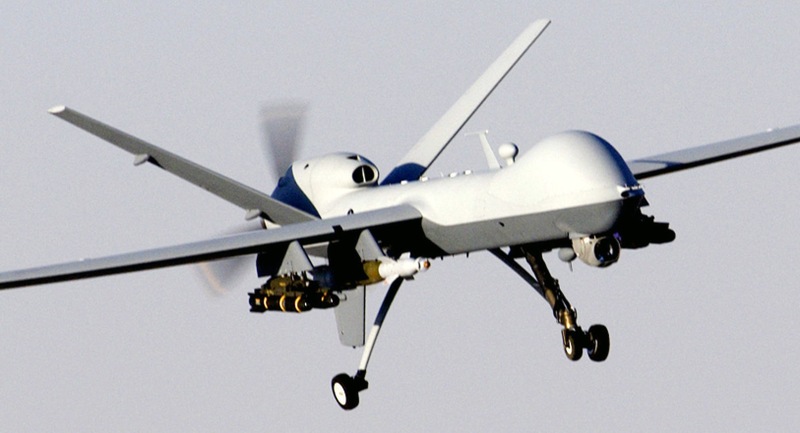
BAE Systems joins the drones PR push with media briefing on Taranis

BAE Systems Taranis
BAE Systems Taranis

After the MoD’s PR push on the use of Reaper drones last month and David Cameron’s announcement last week of further funding for UK-France work on a future combat drone, this week its BAE Systems turn to push drones with a media briefing on their new Taranis drone.

As well as working on a range of technology aimed at enabling drones to fly, BAE Systems has been working over the past few years on two specific unmanned aircraft; the Reaper-class Mantis and the more advanced unmanned combat drone, Taranis.   While Mantis seems to have stalled, BAE have today revealed some more details about Taranis, announcing  that the first flight took place on August 10, 2013 at an undisclosed location and other flight tests, again undisclosed, have taken place since.

Taranis is another expansion in the use of armed unmanned systems. Drones like Taranis and the US X-47B are not flown by pilots on the ground but fly autonomously, taking off, flying a mission, and returning to land by themselves.    BAE Systems and the UK MoD insist that there continues to be a person-in-the-loop, “overseeing” the drone, particularly if it ever comes to launching weapons, yet Taranis is undeniably one more step towards autonomous weaponry.

Chris Cole, Director of Drone Wars UK said:

“The development and deployment of ‘First Strike’ nuclear weapons brought the world to the brink of disaster during the Cold War.  In a similar escalation, this new generation of autonomous, stealthy drones, designed to be used in the ever expanding global war on terror to launch armed strikes wherever ‘our interests’ are threatened, simply makes the world a more dangerous place.”


Background

In December 2006 the MoD signed a contract for a £127m project to design and build an experimental unmanned combat drone, called Taranis.   In its response to a questions from the Defence Select Committee in 2008, the government stated that

“TARANIS will address a range of technology issues including low observable signature technology integration, vehicle management (including autonomous operation), sensor and payload integration, air vehicle performance, command and control and communications integration.”

Taranis was unveiled to journalists in 2010 (although they had to stay 10 metres away!) and was due to make its first flight in 2011. This deadline was missed and it was later  announced that the first flight would occur in early 2013.

Primarily BAE Systems is hoping to persuade the MoD to buy its drones to fulfil Scavenger, a programme which the MoD’s policy document on unmanned aerial vehicles states is aimed at providing UK forces with “a theatre-wide, persistent Intelligence, Surveillance and Reconnaissance (ISR) capability and an ability to attack land and maritime time-sensitive targets.”

The MoD estimates that the Scavenger programme (which is part of a wider  intelligence gathering and analysis plan called Solomon) will cost £2 billion.  It should be remembered that the UK is operating armed Reaper drones in Afghanistan under Urgent Operational Requirement (UOR) rules, meaning that the cost of purchasing and operating Reaper, like the cost of all UK military operations in Afghanistan, is not funded out of the efence budget but out of the Treasury Reserve.

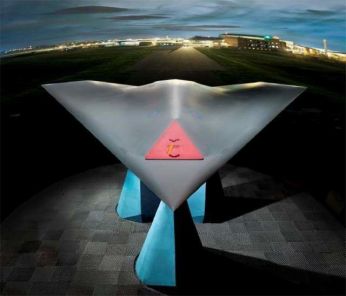
Wither Telemos?

Mock up of Telemos drone on display

British and French Defence Ministers Phillip Hammond and Jean-Yves Le Drian met in London on Tuesday to discuss progress of the Anglo-French defence treaty signed in 2010.  A key element of the treaty was to work jointly on unmanned drones and related technology (see this previous posting).

BAE Systems and Dassult Aviation, who are working together on a proposed medium altitude, long endurance (MALE) drone called Telemos had suggested that contracts could be signed at the Farnborough airshow earlier this month, and when that failed to happen it was suggested that an announcement would be made at this week’s Defence Ministers meeting.  However no such agreement or contract has been signed and there was not even a  mention of Telemos in the post-meeting statement.

Two different agreement were reached about drones.  Firstly a relatively small contract (€13 million) was signed to undertake further basic research work on a future combat drone preliminary dubbed the Future Combat Air System (FCAS) intended for use between 2030 and 2040. Secondly France agreed to evaluate the British-Israeli Watchkeeper drone.  According to DefenseNews “France is acquiring one system from the U.K. to conduct tests and operational studies, expected to last to mid-2013, which may lead to a future French Army acquisition.”   

The silence on Telemos in the post-meeting statement is deafening.  The new administration in France said in May that it was going back to ‘square one’ on the development of a new armed drone   and it seems as though France is keen for Germany and the European conglomerate, EADS to be allowed into the project to join BAE Systems and Dassault.  Some in France are suggesting that France may opt out altogether of investing in a new MALE drone and simply acquire the Reaper from the US.  If this happens in theory the UK could just continue with developing the new drone on its own – presumably based on BAE’s Mantis drone.  By coincidence (!)  BAE has just announced that the Mantis prototype is being brought out of moth-balls and will begin to undertake more flight tests.  However the cost of developing and operating a new drone has been estimated by the MoD to be in the region of £2 billion – a huge amount to invest in a new weapon system at this time of severe economic difficulty.

Latest news on British drones

Some new information has emerged this week about future British drone programmes as BAE Systems held a media briefing at their Warton site to talk about their unmanned projects (our invitation was presumably lost in the post).

Picture of Taranis at Warton, released by BAE Systems.

According to the report by Defense News the first flight of BAE’s Taranis drone has been put back yet again until 2013.  Originally due to make its maiden flight in 2011, it was first delayed until early 2012 for “technical and other reasons” but now won’t fly at all this year.  Little has been heard about Taranis since it was unveiled to journalists (and protestors) in July  2010.  At the briefing journalists were allowed a distant peak at the drone as it sat in its hangar.  The UK government gave BAE Systems £40m of funding to develop unmanned combat systems in January 2012.

Perhaps surprisingly BAE told reporters that it was restarting its Mantis programme. Mantis is an armed medium altitude, long endurance (MALE) drone of similar size and shape to the Reaper.  Unlike Reaper, however Mantis is not remotely controlled but flies autonomously following a pre-programmed flight plan.  Mantis reached the end of its development phase when it flew for the first time at the Woomera test range in Australia in October 2009. Until now it has been suggested Mantis would simply form the basis of the proposed joint BAE-Dassault drone, Telemos.

BAE also said it hoped it would sign contracts with the UK and French government to further develop the Telemos drone  at the Farnborough airshow next month.  Telemos is BAE and Dassault’s offering to fill the UK-French ‘requirement’ for a new armed drone. However the change of administration in France has created uncertainty about the proposal as the newly appointed French defence minister announced in May that he was going back to “square one” on the plan to build a joint military drone.  

Elsewhere BAE continues to undertake work to in order to allow unmanned aircraft to fly within UK airspace.  As part of the ASTRAEA (Autonomous Systems Technology Related Airborne Evaluation & Assessment) programme, BAE will begin undertaking a series of test flights using a converted Jestream aircraft that can fly autonomously as an unmanned aircraft.   At least twenty test flights will take place over the Irish sea over the next six months.  BAE issued a glossy diagram to explain the work that they will be undertaking (large pdf here). 

The other main ‘British’ drone, Watchkeeper – which is being jointly developed by Israeli company Elbit Systems and Thales UK – seems to have missed out on being chosen by the French army as their new drone.  As part of the Anglo-French defence treaty, France was supposed to consider Watchkeeper for the contract but it was announced this week that they have instead bought further Sperwer MKII drones from French company, Sagem. Given this new contract and the fact that France have announced they are withdrawing early from Afghanistan it is unlikely that the French will want Watchkeeper as well.   For more info on Watchkeeper follow Wandering Raven’s blog and see this recent comprehensive article.

Finally, I can’t finish a post about British drones without mentioning the Reaper.  The Guardian reports this week that British reapers have now fired 281 weapons in Afghanistan up until the end of May 2012 and rightly points out that MoD continues to insist that only four civilians have been killed in these British drone strikes whilst at the same times maintaining that they cannot know how many people have been killed.  

 In the article, human rights lawyer Erica Gaston argues

“there has been little to no visibility on how drone targets are selected or reviewed. There have been many cases in Afghanistan and elsewhere in which the visual identification of a “target” through drone technology proved catastrophically wrong. Such past mistakes have raised the bar on the level of transparency and public accountability required. The ‘trust us’ approach is no longer good enough where drones are involved.” 

Quite. Interestingly, the Labour MP Madeleine Moon, who is on the Commons defence select committee, also said: “Greater priority must be given to ensure those killed in drone attacks are not innocent civilians. Current figures coming out of the Ministry of Defence do not indicate that the level of scrutiny needed is in place. It is imperative that steps are put in place, not only to protect innocent civilians, but demonstrate that have done so.”

In stark contrast to this suggestion, the MoD have written to me (letter here) saying they will no longer answer my Freedom of Information requests on the use of UAVs in Afghanistan “until at least the end of operations in Afghanistan.”  Needless to say I have appealed (letter here) and will continue to demand more transparency and public accountability on the use of  British drones.

Drones: as military use expands, civil use being developed

Just a few days after a senior US counter-terrorism expert warned  that US drone strikes were turning Yemen into the “Arabian equivalent of Waziristan”, US drone strikes yesterday aped the tactic of ‘follow up’ strikes used by the US in Pakistan.

According to CNN, a strike in which seven  suspected Al-Qaeda militants were killed was followed by a strike on local residents rushing to the scene to help the injured.  Local sources said that between eight and twelve civilians were killed in the second, follow-up strike.  A Yemeni security officials expressed regret for the civilian casualties and injuries. “The targets of the raids were not the civilians, and we give our condolences to the families of those who lost a loved one.”

Over the past few weeks US drone strikes and other military activity has been ratcheted up in Yemen as the White House has given ‘greater leeway’ to the CIA and JSOC to launch attacks.  Micah Zenko at the US Council on Foreign Relations estimates there will be more US strikes this month in Yemen than there has ever been in a single month in Pakistan.  For details see the Bureau of Investigative Journalism’s excellent database of US covert activity in Yemen.

Drone strikes continue in Pakistan of course and no doubt in Afghanistan although almost no details of these are released.  Last week the US apologised after a strike killed a mother and her five children in Afghanistan but it was not revealed if the strikes was from a drone or a manned aircraft.

Drone fatalities continue to spread around the globe.  As we reported last year, US drones from Iraq were moved to Turkey to help the Turkish military “monitor” Kurdish separatists.  Today (16 May) it was revealed by the Wall Street Journal that information from one of these drones led directly to a Turkish military attack in which 38 civilians were killed last December.   Last week an engineer  working for an Austrian company was killed and two others injured when a drone they were demonstrating to the South Korean military crashed.

Meanwhile preparations aimed at  enabling the use of unmanned drones to fly  in civil airspace continues at a brisk pace both in the US and the UK.

Yesterday the US Federal Aviation Administration (FAA) announced that it had met the deadline for the first changes demanded by the new FAA Act aimed at allowing drones to fly in US civil airspace by September 2015.  The Act mandated that the FAA must streamline the process for government agencies to gain Certificates of Authorization (COA) to fly drones  within US civil airspace within 90 days.

Meanwhile in the UK BAE Systems has begun a series of flight tests over the Irish Sea as part of a programme aimed at allowing  unmanned drones to fly within UK civil airspace. BAE Systems is one of a number of military aerospace companies funding the ASTRAEA (Autonomous Systems Technology Related Airborne Evaluation & Assessment) programme.  According to the  ASTRAEA website it is “a UK industry-led consortium focusing on the technologies, systems, facilities, procedures and regulations that will allow autonomous vehicles to operate safely and routinely in civil airspace over the United Kingdom.”

According to The Engineer, BAE has fitted an “autonomous navigation system” on a Jetstream 31 passenger aircraft to enable it to fly without a pilot – although a pilot was on board in case of problems.

A BAE spokesperson told the Guardian that the tests “will demonstrate to regulators such as the Civil Aviation Authority and air traffic control service providers the progress made towards achieving safe routine use of UAVs [unmanned air vehicle] in UK airspace.”  Further flights  will take place over the next three months  testing infra-red systems as well as ‘sense-and-avoid’ systems.

BAE salivating at prospect of £2bn drone contract as USAF recruits kids to the drone wars

At a pre-Paris Air Show briefing this week, BAE Systems and Dassault Aviation could hardly contain their excitement at the prospect of being awarded a contract to develop a new armed drone.   The companies say they expect a government decision on the new joint UK/France drone programme in the very near future.  The MoD have estimated the new programme to total around £2 billion.

Development of a new armed drone is one of the ‘first fruits’ of a military co-operation treaty signed by France and the UK in November 2010.  BAE and Dassault signed an agreement to work together on the proposed programme in February, with BAE’s Mantis drone expected to be the basis of the new development.

Ian Fairclough, BAE’s Director of Strategic UAV’s stated: ‘We believe we are ready to begin the programme now. We have got some fairly mature plans in place for BAE Systems and Dassault to go ahead with this and we have also mobilised a joint team to work on this.’

Meanwhile, the USAF has just released a new video  game on its recruitment website aimed at teenagers  that enables young people to play at being a drone pilot and carry out drone strikes.   Many have already pointed out the similarity between video games and the operation of drones, and indeed how drones can blur the distinct between the reality of warfare and gaming.

Drone Strikes: Just Kids Play?

Although supporters of drones technology refute any such connections, their denials  are undermined by reports showing that gaming software and hardware are being used  to control UAVs.   Wired.com quotes Mark Bigham, business development director for Raytheon’s tactical intelligence systems as saying: “Gaming companies have spent millions to develop user-friendly graphic interfaces, so why not put them to work on UAVs [unmanned aerial vehicles]?”

What cannot be denied, is that the rapid increase in the use of drones has led to a shortage of drone pilots and hence the need to boost recruitment.

Enticing young people to join the military with video games – with the idea of then moving them on  from playing at drone wars to actually undertaking drone strikes  – is, disturbing to say the least.   When CIA Director Leon Panetta called drone strikes “the only game in town” little did he know how prescient his words would be.

BAE ties up with Dassault not EADS on joint drone

BAE Systems have announced this morning that they have signed a Memorandum of Understanding (MoU) with French aircraft manufacturer, Dassault, to work together on a new armed drone.   The new drone will be one of the first products of the new Anglo-French defence treaty signed last November,  and will be based on BAE’s Mantis drone.

There had been speculation that BAE would tie up with European arms conglomerate, EADS, and combine Mantis with EADS Talerion drone, but this is obviously not to be.  

More on this story soon.