Drone footage shows ‘manifestly unlawful’ US strike on civilians; Trump vows to rip-up drone treaty

The US killed 11 people in a reported drone strike on a small boat in the Caribbean Sea on 3 September. Although it has not been confirmed that the strike was carried out by a drone, President Trump shared drone footage of the strike on his social media. In August it was revealed that Trump had secretly signed a directive ordering the Pentagon to begin military  operations against drug cartels.

Screen grab from drone video shared by President Trump.

While US officials alleged that the boat targeted was carrying drugs being transported by members of the Tren de Aragua cartel, multiple legal scholars and experts have argued that the strike was “manifestly unlawful.”

Professor Luke Moffett of Queens University Belfast told the BBC that while “force can be used to stop a boat, generally this should be non-lethal measures.” Any use of force must be “reasonable and necessary in self-defence where there is immediate threat of serious injury or loss of life to enforcement officials.”  The US and other states regularly stop boats in international waters as part of law enforcement activity without resorting to the use of lethal force.   

Much more significantly, however, is the grave violation of international law that is deliberate, premeditated targeting of civilians. Claire Finkelstein, professor of national security law at the University of Pennsylvania, said “There’s no authority for this whatsoever under international law. It was not an act of self-defense. It was not in the middle of a war. There was no imminent threat to the United States.”  Finklestein went on to make the clear and obvious connection between the strike and the on-going, two-decades long US drone targeted killing programme which has significantly blurred the lines between law enforcement and armed conflict.

While the US alleges that the occupants of the boat were members of an organised criminal gang and President Trump and other administration officials have began to publicly talk about the threat of ‘Narco terrorists’, that in no way makes the targets of this strike combatants under the laws of war.  While civilians are regularly and persistently victims of  drone and air strikes, the deliberate targeting of non-combatants is still shocking.

New York University law professor Ryan Goodman, who previously worked as a lawyer in Pentagon, told the New York Times that “It’s difficult to imagine how any lawyers inside the Pentagon could have arrived at a conclusion that this was legal rather than the very definition of murder under international law rules that the Defense Department has long accepted.”

In the aftermath of the strike and questioning by the media, administration officials struggled to justify the legality of the strike, resorting to arguing that it was a matter of self-defence. Significantly, senior officials said that further such operations were likely

Trump and the MTCR

Meanwhile, President Trump is reportedly returning to a plan formulated during his first administration to overturn controls on the export of US armed drones. Trump attempted in 2020, as we reported, to get the other state signatories of the Missile Technology Control Regime (MTCR) to accept that Predator/Reaper-type drones should be moved out of the most strongly controlled group (Category I) into the lesser group (Category II). Other states, however, gave this short shrift, much to Trumps annoyance.     

According to the Reuters report, the new move involves “designating drones as aircraft… rather than missile systems”  which will enable the US to then “sidestep” its treaty obligations. The move will aid US plans to sell hundreds of armed drones to Saudi Arabia, UAE and Qatar.  

Whether this will convince other states is highly doubtful, but it is likely that Trump and his administration will not care. Such a move will of course open the flood gates for other states to unilaterally reinterpret arms control treaties in their favour in the same way and will also likely spur the proliferation of armed drones which will only further increase civilian harm.  

US spy drones out of ‘RAF’ Fairford – public meeting and demonstration in January 2025

Drone Wars, together with Oxfordshire Peace Campaign and CND, will host an online public meeting and in-person demonstration in January 2025 to oppose flights of US Global Hawk and Reaper drones from RAF Fairford military base in Glos.

The US Air Force (USAF) has applied to the UK’s air regulator, the Civil Aviation Authority (CAA), to change airspace rules to allow RQ-4 Global Hawk and MQ-9 Reaper drones to fly regularly from RAF Fairford in Gloucestershire.

In August 2024, a US Global Hawk drone flew into Fairford, conducted two sorties over the following days and then departed.  It appears these were two ‘demonstration’ flights to trial temporary air corridors.  Following a Post-Implementation Review, in which it was revealed that ten flights into Birmingham airport had to be diverted because of the drones flight, the CAA has ordered the USAF/MoD to investigate “mitigation strategies” to resolve the impact on Birmingham Airport.

According to one document submitted to the CAA, the “working assumption” by the USAF is that the corridors would be activated 2-3 times per week but they are “exploring activation periods that exceed these assumption, both in frequency and time periods of utilisation.”  The proposal is that the drones would take off and land overnight: “all activations will be between 1 hour after sunset and 1 hour before sunrise unless in extremis.”   While the application to fly Global Hawks from Fairford is on-going, the application to fly Reapers has been ‘paused’, likely till after Global Hawk flights have been approved,

Online public Meeting:  Wednesday 15th January, 7.00pm – 8.30pm

Join us online to learn more about these dangerous development
and its worrying consequences both locally and globally.

Please register here:  Eventbrite registration

Demonstration at RAF Fairford:  Saturday 25th January, 1pm, Main Gate

 UPDATE:  Protest will go ahead.  

Bring banners and placards, food for lunch, and dress appropriately for the weather.

Demonstration will be by the main gate  at corner of Horcott Road /Maine Street.
Postcode for Sat Nav: GL7 4DL

There will be parking for some cars at main gate with additional parking nearby (See below)

There are some spaces available on mini-bus from Oxford  £10/£5 low-waged.

Pick up point will be the Ashmolean Museum with minibus departing at 11.15 am.
To book a place email: oxonpeace@yahoo.co.uk  on first come/first served basis.

If you can make a donation to cover cost of transport we would be grateful.  Read more

US ramps up spy drone surveillance of Occupied Palestine, Syria, Jordan and Lebanon

With US Global Hawk drones to fly from Gloucestershire, US-UK collaborations are set to increase

USAF RQ-4 Global Hawk drone

The US military appears to have significantly increased the frequency of its reconnaissance drone missions over Occupied Palestine and neighbouring countries, according to flight tracking information identified by Drone Wars. The flights point to intensified US intelligence interests in the region, though the question of their precise purpose – whether general military intelligence, or more targeted surveillance – remains unclear.

The United States maintains an air base at Sigonella Airport in Southern Italy, from which it flies Global Hawk, MQ-4C Triton, and Reaper drones over Europe and the Middle East. While Reaper drones appear only sporadically in publicly-available flight radar registers, data shows that Global Hawks stationed at Sigonella flew missions across the Mediterranean at least twenty times through September, October and early November 2024, regularly crossing into the airspace over Gaza, the West Bank, and Jordan. On other occasions, flights spent hours circling off the coast of Israel, or, in the case of a Triton naval surveillance drone, flew northwards over Lebanon and Libya. Available data suggests that this marks a significant increase, with only one such deployment of a Global Hawk from Sigonella identifiable across June and July. As war and genocide in the region has escalated, expanding to devastating consequence into Lebanon and Syria, this uptick demonstrates an increased dependence on drone capabilities for US military intelligence.

The Global Hawk drone was developed by Northrop Grumman in the 1990s to maximise aerial surveillance capacity for the US military. With its advanced sensors and extensive operational range, the drone can remain airborne for over 30 hours, covering vast areas without the risk posed to crewed aircraft in territories deemed hostile. The drone’s high-resolution imaging systems and radar communications enable it to provide real-time data that informs military strategy, but which leaves communities subject to its missions under relentless aerial surveillance.

Global Hawk 11-2046 mission from Sigonella Air Base, 13th November 2024

In Palestine, surveillance is already inescapable. Long prior to the onset of the current war, Palestinians in Gaza and the West Bank have been consistently subjected to round-the-clock observation, tracking and monitoring through extensive infrastructures of surveillance, including ubiquitous facial recognition technology. Israeli quadcopter drones, many of which are also fitted with deadly attack capabilities, hover constantly. Palestinians report the psychological harm wrought by this permanent monitoring, which threatens to enact more death at any moment. Read more

US military drones set to fly from UK from 2024

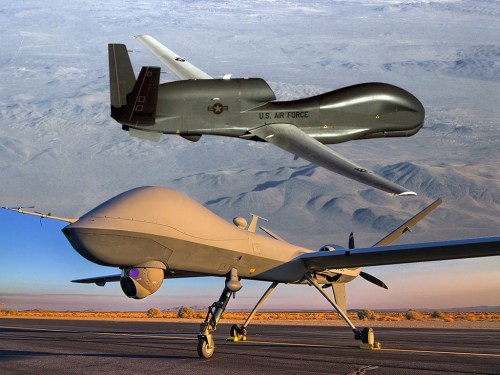
Top: US RQ-4 Global Hawk, bottom: US MQ-9 Reaper

The US Air Force (USAF) has applied to the UK’s air regulator, the Civil Aviation Authority (CAA), to change airspace rules to allow RQ-4 Global Hawk and MQ-9 Reaper drones to fly from RAF Fairford in Gloucestershire.

The application for Global Hawk flights envisages them beginning in 2024.  A recent update of the Reaper application states that while “the USAFE requirement for MALE RPAS at RAF Fairford remains” it is temporarily pausing the process while it reassesses how to comply with the current regulatory framework.  While nominally described as an ‘RAF’ base, Fairford is wholly operated by the US Air Force.

Currently, drones that fly beyond visual line of sight (BVLOS) are not allowed to fly in the UK unless in segregated airspace. The USAF, through the Ministry of Defence (MoD), is seeking to put in place segregated corridors to allow these drones to transit through UK airspace.  The RAF is currently going through the same process to enable it to fly the UK’s new ‘Protector’ armed drones from RAF Waddington in Lincolnshire.  The USAF may be awaiting the CAA’s decision in this case (due very soon) before proceeding with its application to fly Reaper drones.

According to one document submitted to the CAA, the “working assumption” by the USAF is that the corridors would be activated 2-3 times per week but they are “exploring activation periods that exceed these assumption, both in frequency and time periods of utilisation.”  The proposal is that the drones would take off and land overnight: “all activations will be between 1 hour after sunset and 1 hour before sunrise unless in extremis.”

Lack of oversight

If this change is agreed there will be very little chance of the public  knowing when or where these US drones will be used operationally.  While the government has said previously that combat operations from US bases in the UK are subject to “joint decision” in reality the government has little say or control over operations from US bases as the framework under which they operate  – the 1951 Status of Forces Agreement – gives jurisdiction to the US, not the UK.

This is a very significant move.  While the war in Ukraine will no doubt be at the forefront of people’s thinking in regard to this development, the US uses drones – surveillance and armed – to enable it undertake air strikes right across the globe, both in areas of armed conflict, but also beyond for so-called ‘targeted killings’. The UN, many individual states and international law experts have condemned the use of drones for these unlawful operations describing them as extrajudicial killings which undermine global peace and security.  Read more

Task Force 99: New US drone unit begins work in the Middle East

Task Force 99 at Al Udeid Air Base, Qatar. (Credit USAF)

A new unit tasked with field-testing aerial uncrewed systems and AI technologies has begun work in the middle east according to the head of US Air Force Central Command (AFCENT), Major General Alexus Grynkewich.  “It’s a small group of super-empowered airmen that I’m going to provide resources to so they can rapidly innovate and experiment in our literal sandbox that we have in the Middle East” the General told the US Air, Space and Cyber conference in September. It is unclear how the description of the Middle East as “our literal sandbox” was received by allies attending the conference.

Some of Task Force 99’s work will be focused on countering the threat of small drones from state and non-state actors, but it will also ‘experiment with off-the-shelf technologies’ in the ‘hope of harnessing new technologies in innovative ways’ according to reports in defence press.

The new Air Force unit is similar to the US Navy’s Task Force 59, which is based in Bahrain and has been conducting experiments with maritime drones for the past 12 months, (although the US has been using maritime drones in the region for a good deal longer). Tension flared in September 2022 between the US and Iran when two of Task Force 59’s surface drones were seized by an Iranian ship in the Red Sea.  After the US demanded that the drones be returned, the Iranian ship released them into the water the following morning.

The US Air Force’s Task Force 99 will mainly be based at Al Udeid Air Base in Qatar but will also have a small ‘satellite innovation cell’ at Ali Al Salem Air Base in Kuwait, from where US and British Reaper drones operate. The Al Udeid unit will ‘experiment with variable payloads on small drones’ according to a report in ‘Air and Space Forces’ magazine.    Read more

A deadly legacy: 20 years of drone targeted killing

On the 3rd November 2002,  a US Predator drone targeted and killed Qa’id Salim Sinan al-Harithi, a Yemeni member of al-Qaeda who the CIA believed responsible for the attack on the USS Cole in which 17 US sailors were killed. While drones had previously been used in warzones, this was the first time the technology had been used to hunt down and kill a specific individual in a country in which the US was not at war – ‘beyond the battlefield’ as it has become euphemistically known. Since then, numerous US targeted killings have taken place in Yemen, Pakistan and Somalia, while other states who have acquired the technology – including the UK – have also carried out such strikes.

At first, the notion of remotely targeting and killing suspects outside of the battlefield and without due process was shocking to legal experts, politicians and the press.  In an armed conflict where international humanitarian law (the Laws of War) apply, such strikes can be lawful.  However, outside of the battlefield, where killing of suspects is only accepted in order to prevent imminent loss of life, such killings are almost certainly unlawful. Indeed in early reporting on the first such attack 20 years ago, journalists noted that the US State Department has condemned targeted killing of suspects by Israel (see article below).

New York Times, 6 November, 2002. Click to see original.

However, the US argued – and continues to argue today – that its targeted killings are lawful.  It has put forward a number of arguments over the years which are seriously questioned by other states and international law experts.  These include  the notion that whenever and wherever that US undertakes military action international humanitarian law applies; that because states where the US engages in such strikes are ‘unable or unwilling’ to apprehend suspects its lethal actions are lawful; and that there should be greater ‘flexibility’ in interpreting the notion of  ‘imminence’ in relation to last resort.

Here are a small sample of drone targeted killing operations undertaken by the US and others.

November 3, 2002, US drone strike on a vehicle in Marib province, Yemen. 
  • Target: Qa’id Salim Sinan al-Harithi

The first drone targeted killing saw a CIA Predator drone operating out of Djibouti launch two missiles at a vehicle travelling through the desert in Marib province, Yemen. The drone’s target was ostensibly al-Qaeda leader Qa’id Salim Sinan al-Harithi, said by the US to be behind the lethal attack on the USS Cole two years previously.  However, also in the vehicle was  US citizen Kemal Darwish and four other men, all believed to be members of al-Qaeda.  As Chris Woods wrote in 2012, “The way had been cleared for the killings months earlier, when President Bush lifted a 25-year ban on US assassinations just after 9/11. [Bush] wrote that ‘George Tenet proposed that I grant broader authority for covert actions, including permission for the CIA to kill or capture al Qaeda operatives without asking for my sign-off each time. I decided to grant the request.’”

Online webinar: Pandora’s box: 20 years of drone targeted killing

Drone Wars has invited a number of experts to mark 20 years of drone targeted killings by offering some reflections on the human, legal and political cost of the practice and to discuss how we can press the international community to ensure that drone operators abide by international law in this area.

  • Agnes Callamard, Secretary General, Amnesty International. Ex Special Rapporteur on Extrajudicial Executions (2016-2021)
  • Chris Woods, Founder of Airwars, author of ‘Sudden Justice: America’s Secret Drone Wars’
  • Bonyan Jamal, Yemen-based lawyer and Legal Support Director with Mwatana for Human Rights, Yemen
  • Kamaran Osman, Human Rights Observer for Community Peacemaker Teams in Iraq Kurdistan
  • (Chair)  Chris Cole, Director, Drone Wars UK

Tickets for this online webinar are free and can be booked at the Eventbrite page here.

Read more