New information about the number of US drone strikes in Afghanistan has been revealed by DangerRoom, the national security blog at Wired.com. According to official US figures supplied to the website there have been a total of 1,160 US drone strikes in Afghanistan since the beginning of 2009. (Note each ‘weapon released’ is counted by the military as a strike; in press reports often several weapons releases at a single location are counted as a single ‘strike’.) This is not the overall total number of US drone strikes as figures have only been given from the beginning of 2009, while US drones have been operating in Afghanistan for several years before that. Read more
Tag: Afghanistan
UK drone strike casualty figures: incredible or just not credible?
This week we have been updated on some basic figures in relation to British drones in Afghanistan. In the House of Lords, Defence Minister Lord Hever detailed the number of UAVs in service in Afghanistan with British forces. As we have previously reported, the number of Reaper drones is due to double over the next few months as the additional five Reapers ordered in 2010 are due to come into service. Read more
Drones and the ‘propensity to kinetic action’

The concern that drones make armed attacks and military intervention more likely is often rejected by the military and the drone industry, who argue that the drone pilots are able to stand above the ‘fog and friction’ of the battlefield and to make dispassionate and rational decisions about whether or not to use ‘kinetic force’.
This argument, however, has been torn to shreds by the release of a mass of papers detailing the US military investigation into a massacre of Afghan civilian on 21st February 2010. Read more
US military investigation damns drone operators
We’re reposting this short report, together with the links to further information, that we have just received today:

Centcom.mil released on 22 March 2012 a declassified 2,100-page report on slaughter of 23 Afghan non-combatants – men, women, children – in February 2010, blamed on Creech drone pilots over-enthusiastically calling in Hellfires on a 3-vehicle civilian convoy.
Minutely detailed descriptions are provided of how drones are directed from screeners at Centcom and pilots at Creech AFB using a battery of secure communications devices: IRC chat, radio, video, satellites, VOIP, telephone, not all of which are coordinated and supervised and thus lead to disaster.
Pilots of choppers which fired the Hellfire missiles claim drone operators cannot be trusted due to lack of contact with real world conditions on the ground and because mission controllers at Creech reward “Top Gun” aggressiveness. Read more
UK Drone Strikes: Peeking Behind the Curtain
We are publishing from today a list of known UK drone strikes in Afghanistan.
The list will be regularly updated when information becomes available.
The UK Drone Strike List is available here
In summary:
- Some details of 80 (40%) of UK drone strikes have been revealed, information about another 150 UK drone strikes remains secret;
- In February 2012 a British Reaper drone tracked a “high value insurgent” over a period of eight hours before launching a drone strike
- Two other reports in the list detail strikes that may possibly be targeted killings
- UK drone strikes are regularly aborted at the last-minute due to the possibility of causing civilian casualties
The growing use of armed drones has raised a number of legal, ethical, political and moral questions. Most of these questions however, are very difficult to address without access to the appropriate information revealing how armed drones are actually being used. While there is some public information about US drone strikes in Pakistan, there is very little information available about US and UK drone strikes in Afghanistan.
Drone Wars UK has repeatedly asked the UK Ministry of Defence (MoD) to release details of the circumstances of UK drone strikes. Unfortunately all such requests are currently being refused.
Since June 2008 the Royal Air Force (RAF) has published a weekly report of its activities in Afghanistan. The reports, called Operational Updates, although far from comprehensive, subjected no doubt to censorship, and apparently primarily produced to portray the RAF in a positive light, nevertheless give occasional brief details of UK drones strikes.
While some mention of Reaper drones was made in the weekly reports in 2008 and 2009, it was not until January 2010 that a Reaper drone strike is first mentioned:
” During the week [a Reaper] fired a Hellfire missile which killed 12 insurgents who were massing to attack a target.”
Since that first piece of information almost one hundred British drone strikes have been mentioned in the weekly reports.
Today we are publishing a list of UK drone strike compiled from the RAF operational reports. We will regularly update the list, both from the RAF reports and hopefully from other sources when they become available.
A Partial Picture Only
We know from a Freedom of Information (FoI) request that there have been 248 British drone strikes to date (29 Feb 2012). This means that the strikes recorded in the weekly Operational Updates represent only 40% of the total number of British drone strikes. Details of the other 60% remain secret and unreported. In addition the reports have obviously been self-selected by the RAF and none of the reports have been independently verified. Tellingly a British strike that took place on 25th March 2011 in which at least four civilians were killed was not mentioned in the weekly reports and all reports of Reaper activity ceased for eight weeks after.
What is revealed
Of the 80 drone strikes that the RAF have given some details about in the weekly reports, about half (39) targeted “attacking insurgents”, “insurgents firing on friendly forces”, or insurgents “preparing” or “massing” to attack. 17 strikes targeted insurgents who were “active”, “armed” or “committing hostile acts”. It is not clear in all cases what this actually means.
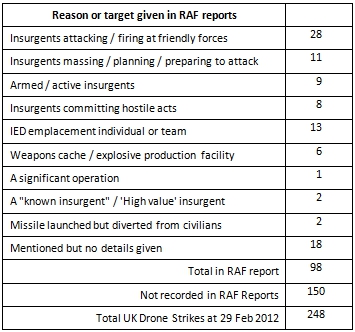 Another 13 of the reported drone strikes were targeted against those said to be individuals or teams emplacing IEDs, with 6 strikes targeting weapons caches or explosive production facilities.
Two of the strikes were targeted at a “high value insurgent” and a “known insurgent”, while a third was detailed as “a significant operation”. These could potentially be targeted killings.
Finally the updates twice report that missiles were diverted away from their targets after being launched from as civilians had approached the target area. The weekly reports detail on a number of occasions the fact that strikes were terminated at the last possible moment because of danger to civilians.
Fatalities
Apart from the very first reported drone strike in 2010, no fatalities had been given. However from June 2011 there appears to have been a change in policy as 17 of the 46 drone strike reported in that period included casualty figures. Of the 18 strikes reported that give such details there were a total of 52 reported people killed.
Missing Details
While it is helpful to have this ‘peek behind the curtain’, it is far too little information to make any proper judgement about the growing use of drones. Apart from anything else, there is no detail at all about the other 60% (150 drone strikes) that have taken place.
In order to begin to answer the questions that have been raised by the growing use of armed unmanned drones, it is vital that more information is released about the circumstances of these strikes. There cannot be proper public accountability for what is being done with this new type of weapon system until a proper, public, informed debate takes place. Such a debate cannot happen without the release of further information.
NATO asks US for Drones “to find stuff to blow up” in Libya
NATO commanders have asked the US to send more Predator drones to Libya to enable them to find more targets. After four months of airstrikes, NATO forces are having trouble locating new military targets. As one senior officer put it “It’s getting more difficult to find stuff to blow up…” So far the Pentagon has not made a decision on whether to grant the request as it will mean moving the drones from Iraq, Afghanistan and, as Pentagon spokesperson put it tactfully “counter-terrorism operations elsewhere.”
 Meanwhile the Ministry of Defence (MoD) have released new figures related to British drone strikes in Afghanistan in response to a question from Green MP Caroline Lucas this week. The figures, which Defence Minister Nick Harvey says are of ‘weapons released’ are for the first time broken down annually, so we are able to fill in more details about the rate of use (see table below). No doubt on some occasions more than one weapon is “released” during individual attacks.
 Also this week two British citizens were arrested in Herat in Afghanistan . Special forces raided the Hotel in which the couple, who are in their twenties and have dual nationality, were staying and they were flown to Kandahar airbase for interrogation. There will no doubt now be a legal battle of what happens to the pair. Clive Stafford Smith form the human rights organisation has offered to represent them. On at least two previous occasions British citizens in Afghanistan have been the subject of a drone strike. It is a step forward that this pair have been arrested rather than assassinated – particularly if as well may be the case, they were only visiting relatives.
We reported last month that France had announced that the UK and France were to delay a decision on the new joint drone by 12-18 months. This was something of a surprise as a decision to go ahead to develop the proposed drone was expected in the summer. France has now announced that it is in talks with Dassault Aviation to procure a version of the Israeli Heron TP drone as a ‘stopgap’ measure. This all smells very fishy and no doubt more will emerge over the coming weeks.