Kathy Kelly and Josh Brollier are co-coordinators of Voices for Creative Nonviolence. They recently spent some weeks in Pakistan and Afghanistan to observe the impact of drone strikes on civilians. Here they are interviewed by Jerome McDonnell of WBEZ Radio in Chicago (24 minutes):
After a two week pause the CIA have resumed drone strikes in Pakistan. According to press reports between seven and fourteen people have been killed in a drone strike on a ‘compound’ near the town of Miranshah in the province of North Waziristan. The BBC reported that tribal elders in the area had told them that many of those killed were civilians staying in a village house.
Meanwhile in the US competion between homeland security and the military for drone pilots has led to US customs and borders being unable to fly drone missions according to testimony in the US congress this week. “There is a significant amount of competition among the DoD (Department of Defense) and DHS (Department of Homeland Security) to hire UAV pilots,” said Customs and Border Protection (CBP) assistant commissioner Michael Kostelnik.
According to AFP, the United States currently has four drones patrolling the border with Mexico in Arizona and one in the northern border with Canada in the state of North Dakota. Two more have been requested this year for the Texas-Mexico border.
An upcoming trial for activists who illegally entered Creech Air Force Base to protest the government’s use of unmanned aerial vehicles has caught the attention of United Nations officials and could have serious implications for the future of remote-controlled warfare.
In April 2009, 14 activists who had gathered here from across the country illegally entered the base’s gates and refused to leave in protest of Creech’s role as the little-known headquarters for U.S. military operations involving unmanned aerial vehicles, or drones, over Afghanistan, Iraq and Pakistan.
Held at gunpoint by Air Force security police until officers from Metro and the Nevada Highway Patrol handcuffed them and took them to the Clark County Detention Center, the activists now face a September trial on misdemeanor trespassing charges.
The activists, whose ranks include members of the local anti-war group the Nevada Desert Experience, had been holding a 10-day peace vigil outside Creech to protest both the use of drones by military and CIA officials and the deaths of hundreds of innocent Iraqi, Afghan and Pakistani civilians they say have been murdered by the unmanned craft.
Activists said they were gladly willing to risk arrest and prosecution — and will continue to do so — in order to alert taxpayers to the U.S. government’s taste for this particularly insidious form of warfare now being waged from just outside Sin City.
“It’s just something that has clearly made killing so much easier,” said Iowa-based activist Brian Terrell, one of the so-called Creech 14 now facing charges. “Removing a combatant from the battlefield has a certain coldness, a weirdness about it. The idea that someone is sitting at a console at Creech and shooting missiles at people half a world away is very spooky.”
Spooky, and very possibly illegal, particularly in the cases of hundreds of innocent civilians who’ve been killed by drones, according to a growing number of international observers.
Sister Megan Rice of the Nevada Desert Experience is one of 14 activists awaiting trial for trespassing.
“These issues raise questions about the law of war and whether you can target nonmilitary personnel who are not engaged in actual combat,” said Richard Falk, professor emeritus of international affairs and politics at Princeton University and the United Nations Special Rapporteur for Occupied Palestine.
Falk said he hopes to testify at the Creech 14 trial in September on potential legal problems with the use of drones. He said his work, which has also focused heavily on similar, so-called targeted killings of Palestinian militants by Israeli officials, has convinced him that drone strikes also raise serious questions of potential war crimes by U.S. military personnel.
“There are two fundamental concerns. One is embarking on this sort of automated warfare in ways that further dehumanize the process of armed conflict in ways that I think have disturbing implications for the future,” Falk said. “Related to that are the concerns I’ve had recently with my preoccupation with the occupation of Gaza of a one-sided warfare where the high-tech side decides how to inflict pain and suffering on the other side that is, essentially, helpless.”
While few, including activists, would accuse al-Qaida militants of being helpless, critics have charged those who suffer most from American drone strikes are the Iraqi, Afghan and Pakistani peasants unlucky enough to live across an entire region now considered a war zone by leaders in Washington, D.C.
Since the United States first used drone strikes in November 2002 to kill an al-Qaida leader allegedly responsible for the 2000 U.S.S. Cole bombing, both the military and the CIA have spent billions acquiring squadrons of the craft to target alleged terrorists and insurgents overseas.
Press reports and independent human rights groups estimate American drones have killed hundreds of Afghan and Pakistani nationals since then, souring relations with those two nations. A July 2009 report from the Brookings Institution found that for every supposed terrorist killed by a drone strike, more than 10 Afghan or Pakistani civilians have been killed, a figure that topped 600 at last count.
Activists agreed with Falk that drones dehumanize killing and said that sense of removal will only ensure future abuses by the U.S. military. That’s why they came to Creech to protest, activists said.
“They’re not only flying drones in Iraq and Afghanistan from Creech, but they’re also training people there to fly them. When you stand outside the gates you can see drones taking off all the time there. No one except the military is really sure where all this is leading,” Terrell said.
For years, Creech has been ground zero for the government’s rapidly expanding use of the unmanned vehicles.
There, amid the high, craggy desert plateaus, pilots with the Air Force’s 432nd Wing continuously fly a fleet of more than 100 drones over large swaths of Southwest Asia and beyond — all from a fleet of nondescript, air-conditioned trailers on this quiet military outpost. Exact details are classified, but base insiders say, at any given time, Creech pilots fly at least 36 unmanned Predators and their beefed-up cousins, Reapers. Cutting-edge satellite technology enables Creech pilots to drop the thousands of pounds of bombs many of their drones carry with barely a two-second delay — all with the twist of a joystick and the push of a button.
Perhaps if military officials were more careful to avoid killing civilians with drones, activists wouldn’t be so quick to sound the alarm, many of them said.
But activists also reserved some of their complaints for Clark County District Attorney David Roger. They said Roger’s decision to prosecute them, while not dissuading hardcore protesters from demonstrating in the future, could have a chilling effect on average citizens who decide to demonstrate against this new type of warfare being waged in their name, with their tax dollars.
It’s a charge Roger strongly denies.
“We don’t have any particular animus toward these protesters, but these citations were submitted to our office, and we felt we could prove [the case] beyond a reasonable doubt,” he said.
Activists, however, contend Roger’s decision to prosecute the Creech 14 represents a larger pattern at work. Across the country, they said, prosecutors and judges are doing all they can to throw activists in jail in an effort to tamp down a growing domestic anger at the warlike policies of both the Bush and Obama administrations.
Court documents from across the country, and press reports from organizations such as Democracy Now and the Tucson, Ariz.-based Nuclear Resister, do show an increase in the number of protesters now facing charges for anti-war activities. While official figures from the FBI for 2010 aren’t yet available, court documents from Fort Benning, Ga., to Lancaster, Penn., show rising numbers of anti-war demonstrators either face charges or are already behind bars for trespassing onto U.S. bases or staging sit-ins at military recruiting stations.
Another problem with the way Roger’s office handled the case, activists said, is they almost didn’t find out about their upcoming trial at all. They never received a letter or a phone call from anyone at the DA’s office alerting them that they were, in fact, being charged.
This problem of gaps in defendant notification has long been reported by defense attorneys across Southern Nevada. It’s a problem Roger said has now been corrected.
“We have suffered cutbacks; right now, we have lost about 60 positions, and some of those positions were in our case assessment unit (the office that notifies defendants of pending charges) … we mail them to defendants at their last known address, but if they’ve moved, our only alternative is to seek a bench warrant,” he said.
Trial or no trial, demonstrators said, neither prosecutors nor drones will dissuade them from staging future protests at Creech.
“People who perform arrest actions or risk prosecution are counseled or coached to be ready for the worst-case scenario,” said Jim Haber, coordinator for the Nevada Desert Experience. “But prosecutions like this do reduce the number of people willing to risk it.”
And that’s a shame, according to scholars like Falk and others. He said protesters like the Creech 14 can have an impact on U.S. foreign policies, particularly in legally and morally nebulous situations like the American drone fleet and the rising number of innocent civilian deaths that result from its use.
“I’ve analogized [the use of drones] to torture, where the victims have no retaliatory capability. It’s why people view torture with a certain moral abhorrence. And while [potential war crimes by the U.S. military] isn’t new, as one moves further and further into this domain of one-sided warfare, it’s really better understood by the terminology of massacre.”
Yesterday, as BAE systems unveiled Taranis, their new unmanned combat drone technical demonstrator at their factory in Warton, near Preston we held a small protest vigil at the front gates. According to Defence Minister Gerald Howarth speaking at the event, the combat drone “reflects the best of our nation’s advanced design and technology skills.”
There was some grumbling amongst those present that details were scant and and Taranis could only viewed at some distance. Indeed the drone, which was supposed to be flying this year, is already a year late. At a cost of £143 million the demonstrator, as the Daily Mail puts it, “spearheads BAE’s drive to convince the Ministry of Defence to invest in the next generation of unmanned aircraft.”
Taranis, named after the Celtic god of thunder, is different from the UK’s current drones as it is designed not to be flown remotely from the ground via satellite, as current unmanned drones are, but rather programmed pre-flight to carry out its mission, whether intelligence, surveillance or armed strike. To make the aircraft ‘more stealthy’ i.e. invisisible to radar, the drone’s bombs and missiles are carried internally.
The company and the Ministry of Defence (MoD) are at pains to point our that the ‘robotic drone’ will absolutely always be in human control. The military are concerned that the public have the wrong attitude to drones and are planning to go to considerable length to re-educate us. Speaking following objections to the allowing of drones to be flown at Salisbury Plain, Lt Cdr Gerry Corbett said
“”The public perception is either: they’re spying on us; they’re shooting at us; or they’re not safe. We are trying to get rid of the phrase UAV. They are aircraft and they are piloted, albeit remotely.”
Speaking up on behalf of the ‘un-reeducated’ we held a small vigil at the gates calling on BAE to work for peace and not war. Response from the hundreds of workers we saw was mostly friendly with our banner, ‘The only good drone is a vuvuzela – Stop Taranis’ raising smiles.
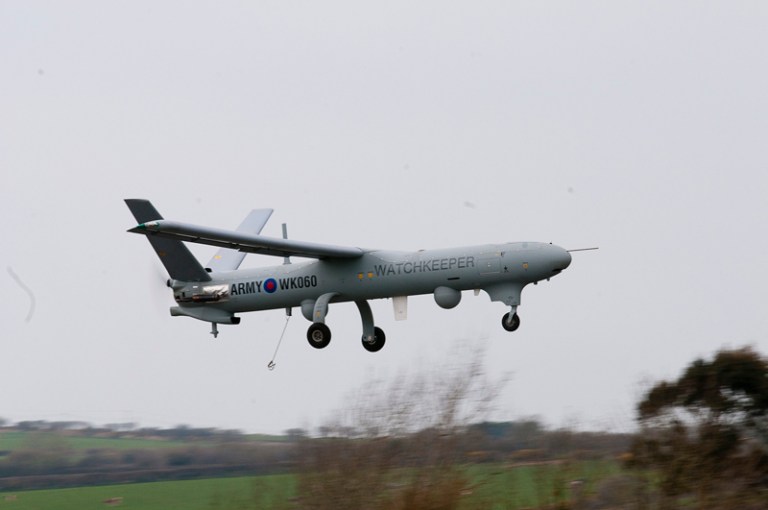
Joint British-Israeli Watchkeeper drone in test flight at Aberporth
While the UK is developing its own “sovereign” drones at BAE Systems and using Reaper drones bought from the US, there is also a strong Israeli connection as the UK are leasing Israeli drones for use in Afghanistan and also jointly developing a new surveillance drone called Watchkeeper.
Israel is the world’s leading exporter of drones with more than 1,000 sold to different countries netting Israel around $350m a year. Israel’s primary combat drones are the Hermes, produced by Israeli company Elbit Systems Ltd, and the Heron produced by Israeli Aerospace Industries. According to Ed Kinkane in the Palestine Chronicle “as far back as 1982 Israel used drones against Syria. In the early nineties Israeli drones were used in the Kosovo campaign and Israeli drones invaded the skies over Lebanon and patrol occupied West Bank and besieged Gaza”. A recent Human Rights Watch report details the use of armed drones by Israel in Gaza.
In October 2005 the UK government awarded a $500m contract to UAV Tactical Systems Ltd. (U-Tacs) a joint venture company formed by Thales UK and Israeli company Elbit Systems, based in Leicester, to build up to 100 Watchkeeper UAVs. Watchkeeper is a derivative of the Israeli Hermes 450 drone but differs in having an automatic landing capability and multiple payload configuration.
In April 2010, Elbit announced that it had signed a $70 million deal to provide maintenance and logistical support for the Watchkeeper project. The announcement came the very day the Watchkeeper drone made its maiden test flight, logging 20 minutes in the air in Wales.
Since July 2007, the UK has also been leasing Israeli Hermes 450 from Thales UK in an innovative ‘pay by the hour’ contract for use in Afghanistan until the Watchkeepers are in service. By April 2010, the leased drones had flown more than 30,000 hours over Afghanistan and the contract is likely to be extended until the Watchkeeper drones are ready to go into service in 2011
This Predator drone crashed near Creech airforce base in April 2009
Today’s LA Times has an interesting article about US Predator and Reaper drone crashes compiled from Pentagon accident reports. The article reports that “thirty-eight Predator and Reaper drones have crashed during combat missions in Afghanistan and Iraq, and nine more during training on bases in the U.S. — with each crash costing between $3.7 million and $5 million. Altogether, the Air Force says there have been 79 drone accidents costing at least $1 million each”. These reports do not, of course, include details about crashes of the CIA’s Predator’s in Pakistan.
In a sign of how touchy the General Atomics, producer of the Reaper and Predator drones are about criticism of their wonderful toy, Rear Adm. Thomas J. Cassidy Jr., President of the aircraft systems group at General Atomics Aeronautical Systems in San Diego is quoted in the article saying
“These airplanes are flying 20,000 hours a month, OK? That’s a lot of flying. Some get shot down. Some run into bad weather. Some, people do stupid things with them. Sometimes they just run them out of gas.”
According to the Air Force reports, one drone crashed into a Sunni party headquarters in Mosul which must have been embarrassing. Another Predator drone was simply reported as ‘lost somewhere in Afghanistan’ after contact was lost and no wreckage found.
When one of the UK’s Reapers crashed in Afghanistan in April 2008, the SAS was sent in to recover “sensitive technology” before it was blown up. The Sun provided a helpful slideshow and report!


 Yesterday, as BAE systems